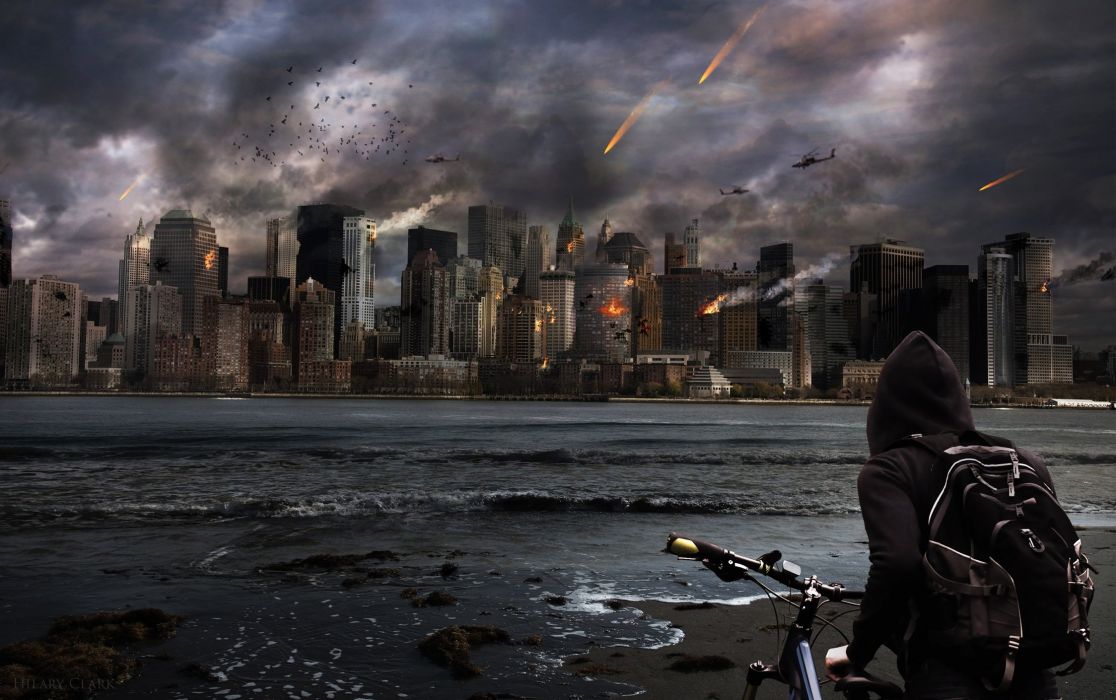
50 Dirt-Cheap Items That Will Be Priceless After The Collapse

Although some survival supplies can be pretty expensive, most of the things people will need after the SHTF are dirt cheap. For example, right now toilet paper costs less than a dollar per roll. But when the store shelves are bare, most people will trade a lot for a single roll of toilet paper. And that’s just the beginning.

When you think about disaster preparedness, keep in mind that a lot of cheap stuff we take for granted will be extremely valuable after SHTF. This is the stuff you want to stock up on now. Not only will you need it for yourself and your family, but you may also need it for bartering.

Here are just 50 examples of cheap items you’ll want to stock up on while they’re still available. I’m sure there are plenty more, so if you think of any, be sure to leave a comment below. Now on to the list…

1. Activated Charcoal

Activated charcoal is a cheap yet potentially life-saving item that many people overlook. It helps treat poisonings, purifies water, and relieves gas and bloating.

2. Aluminum Foil

Aluminum foil has dozens of uses. Buy lots so you can use it for cooking, cleaning, gardening, fire making, and many other things.

3. Ammunition

Ammunition is fairly inexpensive, depending on which caliber you get. However, the price could skyrocket if Democrats take power in the U.S., so get it while you can.

4. Baking Soda

Baking soda isn’t just for baking. You can use it for many things such as cleaning, deodorizing, brushing your teeth, and more.

5. Bandages

Bandages are only a few bucks for dozens of them. Buy a lot so you can treat minor wounds, which will become very common in an SHTF scenario where you’re working outdoors, clearing debris, fixing broken windows, and so forth.

6. Batteries

AA batteries are less than 50 cents each, but during a long-term power outage, they’ll be worth a lot more than that.

Collection of Assorted Batteries

7. Can Openers

You can get a simple can opener for just a few dollars. Can you imagine having all that canned food and no can opener?

8. Candles

Candles are fairly cheap and you will be surprised at how many you will go through. Candles can be used in place of flashlights to conserve battery power. And if you know how to make them, you can sell them when they’re no longer available in stores.

9. Candy

Candy will be an excellent way to keep the kids happy and reward them for helping out during hard times. It’s fun for adults, too, and a great way to boost morale when times are tough.

10. ChapStick

Chapstick is more important than many people realize. When you’re outside working in cold or windy weather, your lips will become chapped and it can be very painful. Plus, there are many other uses for it, some of which may surprise you.

11. Cheap Wine

Cheap wine is easy to come by and will store forever. After fighting all day, a nice glass of wine will go a long way toward calming the nerves. It also makes for a great barter item.

12. Cigarettes

Cigarettes may not be healthy, but after the SHTF, they are going to be in very high demand. A single pack could be worth a lot of supplies.

13. Condiments

Condiments like ketchup, mustard, salsa, and Tobasco sauce can sit on the shelf for years without going bad, and they can make an ordinary meal taste a lot better.

Condiments in Fridge

14. Condoms

Because having lots of babies after the SHTF is not going to be ideal, and chemical birth control probably won’t be available.

15. Cotton Balls

Cotton balls can be used for cleaning, treating wounds, and protecting the ears when you have to be outside in the bitter cold.

16. Duct Tape

Duct tape has all sorts of uses, from building shelter to treating wounds to fixing just about anything. Be sure to buy several rolls because you’ll need more than you might think.

17. Feminine Products

Feminine products will be in high demand as women get used to a new way of living without the luxury of feminine hygiene products in the stores.

18. Fishing Line

Fishing line isn’t just for fishing. You can use it to hang up items, make a snare trap, and set booby traps around your camp.

19. Glow Sticks

Glow sticks can serve as night lights, trail markers, signals, and more. They are very cheap, but very useful. (Bonus tip: These are really cheap right after Halloween.)

20. Hand Sanitizer

Hand sanitizer will be very useful when water is in short supply and you need to keep your hands clean.

21. Kleenex

People will continue to get colds and have allergy problems after the SHTF, and you don’t want snot everywhere or a raw nose.

22. Lighters

Lighters will obviously be useful in a disaster scenario, and they’re excellent barter items. Buy them in bulk and keep one with you at all times.

23. Lotion

Lotion can help prevent cracked and chafed skin which, for some people, can become a serious problem if left untreated.

24. Matches

Matches can be purchased for just a few dollars. Store hundreds or thousands if you can. Without stoves and heaters, you will have a lot of fires to start after the SHTF.

25. Nail Polish

You might be surprised how many survival uses there are for nail polish.

26. OTC Medications

OTC medications like aspirin, ibuprofen, and acetaminophen do expire eventually, but the first few years of a post-apocalyptic world will be a lot easier if you have them.

27. Paper Clips

Paper clips aren’t just for clipping papers together. You can use them to fix things, make a compass, make fishing hooks.

28. Paper Plates

In a disaster scenario, you might not have running water. If that happens, you won’t want to waste a single drop of your stored water. By using paper plates, you won’t have to waste water on washing dishes.

29. Paper Towels

You probably use these every day, and I guarantee you’ll still be using them every day after the SHTF.

Paper Towels On Table

30. Pens, Pencils, and Paper

Pens, pencils, and paper can provide entertainment as well as a way to send information and document your new way of life. In fact, if it’s the end of the world as we know it, you should definitely keep a journal. Not only will it be valuable to future generations, but it will also be therapeutic.

31. Plastic Sheeting

You’ll need this to cover broken windows, repair roof leaks, and setting up a medical quarantine.

32. Ponchos

Ponchos can be picked up at any dollar store. You can’t afford to get wet when it’s cold out.

33. Rubber Bands

These cost next to nothing, but there are at least a couple dozen uses for them, especially when it comes to organization.

34. Rubbing Alcohol

This is one of the things that disappeared from the shelves right after the pandemic began. Why? Because you can use it to make hand sanitizer. It’s also important for disinfecting in first aid situations.

35. Salt

Salt makes food edible and can be used for cleaning, de-icing in the winter, repelling pests that are invading your camp, and many other things.

36. Seeds

Seeds to grow a garden will be crucial to creating a sustainable life. Store a large variety of heirloom seeds so you’ll also have seeds for next season and so on.

37. Sewing Supplies

Sewing supplies will be needed to mend your clothing when you can no longer stop by Walmart any time you need new clothes.

38. Shoestrings

Shoestrings aren’t just for keeping your shoes on. They can be used as cordage for all sorts of things, from setting traps to building shelter.

39. Soap

Soap is so cheap today that we tend to take it for granted. But when it’s gone, people will miss it badly. It is crucial to maintaining cleanliness after the SHTF to keep diseases from spreading.

40. Socks

Another simple item that people use every day and tend to take for granted. You don’t want to be stuck wearing wet socks all day. Or worse, no socks.

41. Spices

Spices like basil, cumin, oregano, garlic powder, seasoned salt, and the like will turn that bland soup or stew into a delicious meal.

42. Sugar

Sugar makes life better all the way around. You want to enjoy the food you eat; not just eat for survival. I know some people will scoff at this, but morale is very important during a disaster.

43. Sunscreen

Sunscreen is very important and needs to be used to prevent serious sunburns that can leave you dehydrated or suffering from heat exhaustion.

44. Super Glue

I can’t overstate how useful this stuff can be for fixing gear or repairing everyday items.

45. Toilet Paper

Toilet paper is pretty self-explanatory unless you are fond of leaves and what-not. If you can’t find any.

Man Hoarding Toilet Paper

46. Toothbrushes and Toothpaste

Toothbrushes and toothpaste should be stored in bulk. Good oral hygiene will be incredibly important when there are no dentists around. You don’t want a bad toothache when that happens. In fact, you may want to put together an emergency dental kit.

47. Towels

Towels can be picked up at yard sales and thrift stores. Use them as intended, to make slings, to blackout your windows, to seal up a drafty door, and more.

48. Vitamins

Vitamins will help keep your immune system strong, which will be crucial when you’re living through the stress of a disaster scenario. Remember, most survival food isn’t very high in vitamins, and your body desperately needs vitamins to stay healthy. Especially Vitamin C.

49. Zip Ties

Zip ties are versatile and extremely useful for putting up a quick shelter, holding a door closed, fixing small things around the house.

50. Ziploc Bags

Ziploc bags will be helpful to store leftover bread and other treats you make, or for keeping socks, tinder, small electronics, and other things dry.

Conclusion

Next time you visit the dollar store, take a walk down each aisle and start stocking up on all the little things that will make life easier after the SHTF.

The United States of America, is on the verge of war…Knowing About This Coming Apocalypse Is The Key To Your Family’s Survival And It’s Only Revealed In This Presentation (All Americans Will Lose Their Home, Income And Power By March 17, 2021)

Hi, my name is Milan Adams and today, in this short article I’ll tell you something only a handful of powerful people have known for more than 10 years… I’ll present you crucial information that might save your life.

I’m talking about one of the best guarded secret of the 21st century that may be a lifeline for you and your family.

Over the past year over 34,000 people have already found out how to protect their loved ones from this dark secret and it can help every American citizen get over tragic milestones such as hurricanes, snow storms or floods.

It was discovered by a stroke of luck in the archives of the Holy Country and its content predicted the turn points for mankind’s history and not only does it hold the answers to many questions already answered, but also to questions not yet asked …

I’m sure you’re already intrigued and you want to know all about this mystery so that you can also be prepared.

Honestly, it’s like nothing you’ve ever seen or heard and in a few minutes from now you’ll be outraged you never knew the danger you and your family have been living in…

So you absolutely need to watch this short presentation today, while it’s still up…

I don’t know how much longer I’ll have this free presentation online, so watch this right now, while you still can

Before we continue, let me tell you who I am, and how it all started.

As I mentioned before, my name is John Stone, a 65 year old historian from Wichita, Kansas, and for the last 20 years I’ve been studying ancient and contemporary prophecies and I’ve witnessed countless revelations most people are unaware of…

While researching, I came across some shocking rumors from inside the White House and I decided to dig deeper into this mystery…

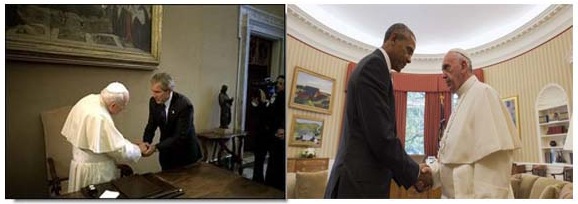
I was shocked to find out a big secret passed on from Bush to Obama and recently to Trump, but we’re being kept in the dark…

This secret deal is more dangerous that any present armed conflict…

It’s a sinister pact between The White House and high ranking officials of Vatican and it will reach its terms in a short while with devastating consequences…

Hidden investigations revealed that the core of this pact is one of Nostradamus’s long lost books that never reached the surface

This book is the best guarded secret of the 21st century and it contains crucial information on horrible events that already happened, and, more important, on America’s morbid destiny…

The events presented by this dark secret reveal that The United States will be hit by something bigger than hurricanes Michael or Florence, bigger than the great tsunami on the coast of Japan that brought over 15,000 deaths and destroyed over 1.1 billion buildings, or even the Indonesian earthquake that reached 9.1 magnitude.

But this time, the chaos will be man-made…

America as we know it will cease to exist… Mayhem, famine, diseases, death will take its place and will spread like cancer…

Don’t think for a second you’re prepared for the dark future that awaits us all…

Yet, before unraveling the much needed information, please give me the chance to tell you who Nostradamus is and why his predictions are so important for each and every one of us…

For centuries people have interpreted the words of Nostradamus and historians, even scientists have been amazed how accurate his prophecies have been…

It is a known fact that time after time Nostradamus predicted the rise of nations and fall of economies

But his darkest prediction has yet to come true. Historians say it’s the most fearful and it means the beginning of the end. Scientist backed up the aspects with hard evidence…

Therefore, before going any further, I must warn you:

Therefore, before going any further, I must warn you:

What you are about to hear is deeply disturbing…

Because the dots that this presentation connects will send shivers down your spine and there will be no turning back once you hear this.

When you see the evidence that this great unavoidable ruination will come to reality, it will simply be impossible for you to go about your daily life like you used to… before knowing the truth…

In all human history no other prophet has so accurately predicted the great events all around the world:

Here are some of his predictions written in 1555 that have already come true:

“The blood of the just will be demanded of London,

Burnt by the fire in the year 66″

– The Great Fire of London from Sunday, 2 September to Wednesday, 5 September 1666

That’s 111 years before it happened. Historians say it’s one of the most accurate prophecies ever told. No other prophet predicted such a devastating event since then.

“From the depths of the West of Europe,

A young child will be born of poor people,

He who by his tongue will seduce a great troop;

His fame will increase towards the realm of the East.”

On April 20th, 1889 Hitler was born in Western Europe, from very poor parents. “By his tongue”, with manipulative oratory skills, Hitler led Germany to action in the years following WWI.

“Near the gates and within the cities

there will be two scourges the like of which was never seen,

famine within plague, people put out by steel,

crying to the great immortal God for relief.”

Nostradamus wrote about the bombing of Hiroshima and Nagasaki that led to death, hunger and unprecedented destruction…

And there are many others…

Yet you must understand, the visions he had could not be explained with the words of the time and he simply described them with the vocabulary he had…

Key persons around the world, who deciphered his undiscovered words, were forced to keep it under the hat…

They have hidden the true meaning of the forthcoming events that will shake us all…

These are previsions told over 5 centuries ago, carefully hidden by Nostradamus himself behind words…

His prophecies predicted Obama’s victory in 2013 as the first black president but few know Nostradamus also predicted the fall of America  by the end of this year due to a power no nation or alliance, be it military or economic, can withstand…

It will hit America at its core and will send us all into medieval times…

I will show you exactly why this knowledge is a closely guarded secret and I’ll reveal the signs that show how close we are to the fulfillment of the prophecy…

The threat comes from an enemy hidden in plain sight that has yet to show its true strength, but will not hesitate to crush anyone who stands against it, no matter how powerful or how technologically advanced it is…

My research lead me to the Vatican library where I found the writings of an Italian journalist who stumbled upon an unusual find, The Lost Book of Nostradamus, dated 1629.

Old historians talked about its existence, yet it did not surface until now…

When reading through it, I stumbled over a unique quatrain:

Earth-shaking fire from the center of the Earth.

Will cause the towers around the New City to shake,

Two great rocks for a long time will make war,

And then Arethusa will color a new river red.

– Charles Nostradamus

After months of hard work, I managed to decipher the true meaning of his words…

“The towers of the New City shake”

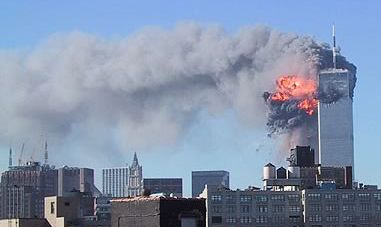
11.09.2001 – the darkest day in American history, YET!

Why would the great Nostradamus himself preach this historical turning point in the “New (YORK) City” as the beginning of the end of times?

It’s the day America was brought down on its knees by leader of Al-Qaeda, Osama bin Laden. It was only the beginning.  A series of attacks against America have followed ever since and in the current geopolitical conditions – the war on Iraq, the war on ISIS, the Syrian and Ukrainian war, the constant terrorist attacks – it’s obvious we’re living in an unstable world that seems to teeter on the edge of complete chaos.

“Two great rocks for a long time will make war”

Besides America, the greatest power on Earth, there is another nation that has been rising for some years both economically and military and threatens our safety…

What country has recently started its violent expansion? What country has the military and economic power to spread chaos?

It’s greater than ISIS, Al-Qaeda, China, Iran, Iraq, all together. It’s the biggest country on earth ruled by the most fearful leader the history has ever seen: Russia with its dreadful leader, Vladimir Putin.

It’s Russia and all ancient prophecies are pointing in this direction.

The war we are on the verge on is foretold even by the HOLY BIBLE: “Think not that I come to send peace on earth: I came not to send peace, but a sword: Matthew 10:34” – Who else has sent “SWORDS” into Ukraine and Syria if not Putin himself? And, again, it’s only the beginning…

“And then Arethusa will color a new river red”

Arethusa, in Ancient Greek, means “the waterer”. The red river is the blood of our brave American soldiers who will die defending the country we all love.

But how will Putin strike using the force of water?

The world has already seen the force of nature. Countless fires, hurricanes, floods, acid rains, earthquakes etc. have struck our beloved country time after time…

It may seem that we are at the mercy of nature.

OR ARE WE?!…

“Earth-shaking fire from the center of the Earth.”

Again, to understand this apocalyptic message we need to look back into the history…

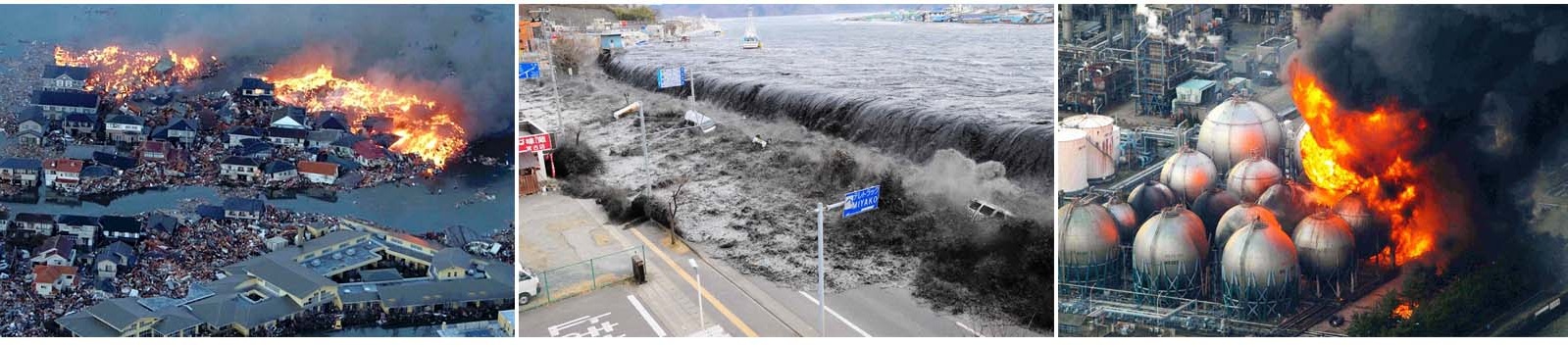
The day is 11 March, 2011. Japan – Eastern Coast. 14.46 local time.

The alarms start to ring. A huge tsunami can be seen across as it darkens the horizon. All hell unleashes over the land as the giant water block reaches the shore at heights of 133 feet.

The water falls down as a wall of bricks that smashes anything in its path.

15,893 deaths, 2,572 people missing, 1,148,067 buildings destroyed. And probably the most important damage the tsunami made – the Fukushima Nuclear Power Plant…

All media stated at that time: “The force of nature”. Key persons running the media as skillful puppeteers are knee-deep in this massive cover up…

You might be tempted to believe this nonsense. Yet, in light of recent discoveries, things tend to look like SCI FI movies, but real hard evidence can back up every piece of information presented here.

Have you ever thought that not all natural disaster can be “natural”?

Over the years there have been many man-made disasters that had economical or military reasons.

Numerous sources claim that the 2011 tsunami was caused by man and the disaster and they were far from natural. [i]

They were also silenced…

This information never reached the surface because it would have meant WW III, as China would have investigated and would have declared war to whoever was responsible.

One of history’s most devastating events was created by man. And the purpose for such actions lies in the blue eyes of the former KGB agent who started his world conquer campaign from the very first day he took over Russia.[ii]

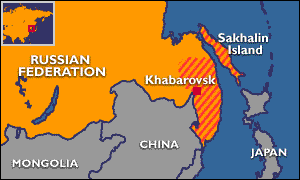
Russia’s military budget has tripled since Vladimir Putin won the elections in 2012. Hidden investigations revealed massive investments in 2 key points on Russian territory…

The first base Putin set his eyes on is Vladivostok. Besides this city, which is actually a military base, Putin has been pouring money into another secret military headquarter. The second key point of Putin’s worldwide campaign is located the Eastern part of the country, where high tech military camps were built in Khabarovsk

While media has been covering only the European and Syrian issue with Russia, Vladimir Putin has been investing in this secret operation and is planning on activating this cell to fulfill his master plan that will lead to a disaster of biblical proportions.

Listen to Brooks Agnew, earth tomographer, explaining this cutting edge technology:

This is the exact technology Putin developed to build a weapon of mass destruction in Khabarovsk.

Sources claim that Putin tested this technology on March 11, 2011 and caused a huge tsunami…[iii]

Hurricane Matthew started forming on September 28th , 2018, when satellite footage showed the same activity in Khabarovsk on a larger scale…[iiii]

It is clear that Russia is preparing to take over the world and Japan and Matthew were mere tests…

Using this technology, he will strike America from distance and he won’t even be traced. So we won’t even know what hit us. The American government is not prepared for such events but you can be…

The consequences of such a powerful weapon will be far worse than Japan when Putin hits us with full throttle!

Anything starting from earthquakes, to hurricanes, massive fire spreads, massive and permanent power-outs!

How will the collapse start?

Firstly, the healthcare, which is already, as we all know, basically on its knees, with less and less personnel and less and less funding, will be overflowed, no matter the crisis…

Your local hospital will be overflowing and the staff probably won’t be able to help you or your loved ones…

During Florence for instance, non-threatening illnesses turned deadly because of lack of personnel, supplies and medicine…

The hospitals are barely prepared for the patients they get daily…

Next, the transport will shut down. You will not be able to travel to safe places to provide food or shelter. Medicine will not be delivered and pharmacies will be emptied in minutes.

And you may think this is the worst part. Yet, you can say goodbye to telecommunications, utilities and running water…

The diseases will spread in an instant, police won’t be able to help anyone (they barely do it now)…

As the great Nostradamus predicted, America will be covered in “rivers of blood” and we’ll all suffer…

So, when learning the truth, I gave it a good thought and decided not to sit around and wait for the disaster to strike.

I began researching every single survival technique I could find to save my family.

I made it my sole purpose because leaving my family’s wellbeing in the hands of the government clearly wasn’t an option.

Not only do they ignore the needs of the American citizens, but they keep us in the dark about the imminent danger.

So I immediately began to look at the problem from every angle because  I wanted to make sure my family never goes through such an experience. There had to be something.

Frustrated, I created a list of what I needed:

  1. how to treat ourselves and others in case of an injury when doctors, pharmacies and hospitals are shut down…
  2. how to protect ourselves from diseases, viruses and any illnesses…
  3. what food, liquids and medicine to stock up and where to find sources of food, water and other necessary materials…
  4. how to keep our appliances running, while the entire US power grid will be down…

And much other useful information…

Being a historian doesn’t really offer those kinds of skill…

So I started looking into every other solution that could bring me the security for my family.

Many sleepless nights passed and I was getting tired of surfing the Internet for a simple and efficient solution.

Yet one day, Emily, my wife, reminded me about my high school friend Rick who is a war veteran.

As a professional in the military field he had all the resources to help me.

After getting back from Iraq he dedicated his life to become an expert survivalist.

So I picked up the phone and called him.

We met up and discussed what I found out. When hearing the facts, he was very surprised. He told me that most of his army trainings consisted of similar threats.

He then explained to me the real secret to be safe in such situations is to know some basic techniques that only military men know. Because he trained in some of the toughest field conditions in the world, he knew them like the back of his hand.

That was the moment I realized I found solution to my problem.

What I didn’t realize however, is just how complex this domain is.

The true secret of it is that it so simple to learn.

And the fundamentals are so easy, yet few know it and it’s rarely used.

So, if properly taught, it can ensure anyone’s safety.

Without wasting a second, the very next day we met and we started sort of a “survival training” at his training camp.

As the training began I swore myself I wouldn’t go back home without the proper skills to survive The Strike.

After many hours of going through dozens of techniques I found what I was looking for and I realized that they held the key to protect my family.

But what I didn’t know exactly was how to apply them in extreme situations…

Rick, being an enthusiast in this field, thoroughly explained them to me.

However, I insisted to set some basic rules:

  • I had to be able to easily teach them to my children .
  • The materials we used had to be easy to find when everything goes South.

As a guy who trained in this domain, Rick had a pretty good idea of the methods that can help you survive under any circumstances. However, learning to apply them wasn’t that easy…

We had some heated arguments, mainly because of me being stubborn – I needed the course to be really easy to understand and teach others…

In the end, after several weeks, we finally came up with the simplest techniques that anyone can understand. Brilliant as they were, they could come in handy for anyone, anywhere.

We only used things lying around his training camp that I never thought could be of such use.

All accessories used during the course wouldn’t have cost more than 50 bucks at Home Depot.

However, I’m sure anyone could also find them around their house for free, if they weren’t in a rush.

But the most important part is that it was incredibly useful and easy to remember.

No risks of injuries or damages, so anyone will have zero worries about their family’s safety.

They simply have to follow the steps in the right order to achieve the skills…

And because of the ingenious way the course was designed…

They’ll be prepared for when Putin strikes with any weapon.

They’ll be prepared for any dangerous situation that might occur.

Even more, the techniques will provide security for anyone’s family, even if you face the most dangerous situations or you need them around the house.

So, after finishing the course, I headed home at peace, knowing that I’m prepared to protect my family from any disaster.

After a while, my family and friends noticed a change in me. They all saw me more relaxed, more confident in myself.

But the first test came shortly.

The next spring we went on our yearly family camping trip. Once a year we have a family tradition to spend a night or two in the wilderness – only us and the nature.

We packed all necessary supplies and headed out.

But this time was different.

At nightfall, as we were preparing to go to sleep, my wife, when moving the food in the trunk of the car, slipped on the wet grass and fell.

I heard a scream in the dark.

She had the bad luck of falling on a choppy rock and cut her calf.

I immediately rushed over and I realized it wasn’t a simple cut. It was deep and it was bleeding fast.

At the sight of blood she panicked and started to shiver.

I calmed her down and told her she was safe and everything would be OK.

I told her to lie on the back, I placed her legs at a higher level than her body, then I grabbed the first aid kit, cleaned the wound and bandaged her leg not to lose any more blood.

After securing the wound, I improvised some leg splints and tied them  with some rope I had in the car, just in case – exactly how Rick had taught me.

Because of the difficult road we couldn’t rush to the hospital that night but as soon as the first rays of sun came we drove off to check the wound.

After thoroughly analyzing the splinters, bandages and the cut, the doctor told me everything was OK and, to my surprise, asked me if it had been done by a healthcare professional because besides changing the bandage, nothing else was needed.

Feeling relieved, we went home. On our way, while driving, I realized how lucky we were that I had trained with Rick for Putin’s Big Strike.

I followed the steps Rick had taught me with such ease and it all came so natural to me that I didn’t even realize it at the moment.

In truth, I almost couldn’t believe how simple all of this was… and how it helped me and my family stay safe.

After a while I gave it a good thought and realized that it had been a great lesson…

In emergency situations you have to rely on yourself and not be dependent on anyone else.

And I felt so RELIEVED to know that I could offer my family the sense of safety and that they would always grow up in a warm, secure and comfortable home.

Now, that was about a year and a half ago…

And since then, my family and I have been more relaxed than I ever thought I would.

I started applying more and more of Rick’s techniques around the house and everything got easier.

Plus, using some of the information, I managed to grow a few vegetables and fruits in my small backyard.

Enough to never worry about extreme situations such as food-shortage.

Well before long my friends and family members were begging to know my secret…

And when I told them about my camp experience and how Rick’s techniques helped me then and on a daily basis…

A lot of them had a hard time believing some survival lessons could be so helpful.

But after I’d given them the simple, clear instructions… and they’d followed them, and even applied some on routine chores with ease… they became believers FAST.

Because when anyone used these amazing plans, the results were the same: sense of security, self-confidence and a safe environment for themselves and their family.

They all learned how to grow and cook their own food, produce their own water, protect their selves and their loved ones from any disaster, how to protect their homes … and more amazing such skills.

Soon my friends were telling their friends about the plans…

Until finally the number of phone calls and emails from people asking me to share them became too overwhelming…

Emily put her foot down and told me that I HAD to find a better way to share this information with the world.

So, I went to work with Rick putting on paper all the techniques, all the knowledge we had in clear simple steps.

Confronting the Judeocracy (Anyone who has spent even a short time battling against the Judeocracy has surely experienced the frustration of attempting to persuade a trusted friend or colleague of the gravity of the situation—only to fail.)

Anyone who has spent even a short time battling against the Judeocracy has surely experienced the frustration of attempting to persuade a trusted friend or colleague of the gravity of the situation—only to fail. This is undoubtedly one of the most discouraging and troubling aspects of those who take up the mission for truth and justice. We repeatedly encounter intelligent and well-read individuals who, we believe, surely must share our sense of concern and outrage. If they do not, it can only be from lack of knowledge; therefore, a short chat or a targeted reading or two, we think, will do the trick. The facts are indisputable, and hence it is merely a matter of information. Once our friends have the requisite facts, they will surely—surely—see things our way. And yet, time after time, they do not.

Why is this? What are they thinking? What is their logic? How is it that they can fail to be fully convinced of the severity of the Jewish Question? Or even just be sympathetic to our stance? Why is it that they occasionally even become outright hostile—not to them, but to us? How can they be in denial of what is, from a rational and objective standpoint, surely one of the major problems facing civilized humanity? Undoubtedly this could be the topic of a book-length treatment, and I can only outline a few basic ideas here. But I think there is some merit in examining the basic categories of response and denial by those confronted, perhaps for the first time in a serious manner, with the Jewish Question and with the many problems of living under de facto Jewish rule.

At its most basic level, the situation is one in which the relative novice is confronted with a difficult, troubling, and potentially catastrophic scenario: profound social corruption by wealthy and powerful Jews. (I stress the ‘relative’ here; everyone, even the functionally illiterate, has heard something negative about the Jews, likely many negative things.) It is a ‘bad news’ story of the highest magnitude. And the last thing many people want in their lives these days is another bad news story. God knows we’ve had enough troubles in recent years: political upheaval, riots in the streets, a global pandemic, economic gyrations, unrestrained immigration, environmental decline, opioid crises, surging crime, falling lifespans. Who needs yet one more disaster heaped upon their plates? The Jews? Really? Are you serious? And I suppose the Holocaust never happened! (Hint: it didn’t—not in the way described.) What are you, some kind of Nazi? A White supremacist? On and on.

Despite all this, many of us persevere. We realize that public education is one of our primary weapons in the Great Struggle, and we are bound and determined to press ahead and inform as many as possible of the nature of the problem. Therefore, it is of some use to understand more precisely how people typically respond to our overtures, in order to be more effective in our communication. After all, we are pursuing a noble cause, and we sincerely want people to be well-informed and, ideally, to join us in our mission. Apart from our opponents, we genuinely want people to like and appreciate us. You don’t get very far coming off like a fanatic or a jerk. I’m quite confident that virtually none of us relish making enemies for the sake of making enemies. We have no driving urge to be antagonistic or rabble-rousing. Generally speaking, what we have are facts, experiences, and informed opinions on the Jews; these, combined with a general sense of concern for social welfare, justice, and the state of the world, incline us to undertake unusual, unpopular, but highly valuable actions to educate others, and to articulate possible solutions. It is the prototypical ‘thankless task,’ and yet we do it all the same.

That said, it is helpful to have a model of how people react to the Jewish Question. The approach I will outline here derives from another famous model describing how people react to a different crisis situation: death. In the 1950s and 60s, Swiss (later, American) psychiatrist Elisabeth Kübler-Ross developed a well-known scheme that came to be known as “the five stages of grief.” When confronted with imminent death, she said, people typically progress through five relatively distinct mental phases: denial, anger, bargaining, depression, and acceptance. Denial: “No, this isn’t true, it can’t be happening. There must be some mistake.” Anger: “How could this happen to me? It’s just not fair! Someone is to blame. God, how could you let this happen!” Bargaining: “Please, God, get me through this and I promise to do x, y, z. Or, doc, you have to help me; I’ll do whatever it takes.” Depression: “There’s no use, nothing will work. I’m doomed. What’s the use of even trying?” And finally, Acceptance: “Everyone dies, and I guess my time is up. So be it. Time to meet my Maker.” This schema was first described in her initial book, On Death and Dying (1969).

I’ll not debate the merits or demerits of Kübler-Ross’ theory here. Some have found it helpful, and others dismiss it as largely irrelevant or at least unsubstantiated. Still, based only on common sense, I think we can see that there is some insight here, and that many people—perhaps some we have known personally—indeed experience such stages in varying degrees. Obviously not everyone passes through all five stages, and not necessarily in the prescribed order, but nonetheless, these stages do describe some essential aspects of human response to the looming tragedy of one’s own demise.

Inspired by this model, let me then propose something analogous: The Six Stages of Enlightenment on the Jewish Question. I claim no real scientific grounding here, and I have done no exhaustive surveys or interviews. This is based simply on my own personal experience, over several years, of confronting people—students, family, friends, strangers—on the dangers of the Judeocracy. My six stages are as follows:

1. Denial
2. Irrelevance
3. Impotence
4. Misplaced Anger
5. Acceptance
6. Righteous Anger and Action

As with Kübler-Ross’s theory, I do not claim that all people experience all of these stages, nor that they necessarily progress through them in order. But I do think that many people, when confronted with the data, do experience some or most of these stages. Let me briefly describe each in turn, and then outline some of the relevant facts that make the case for enlightenment.

DENIAL. Upon first hearing a serious claim that Jews have outsized and detrimental influence in society, or dominate the ranks of the wealthy, or run the media, or control politics, the usual initial response is denial: “No they don’t. That’s ridiculous. There are no more Jews in power than anyone else. That’s just an anti-Semitic canard.” This, even from highly-educated people. Fortunately, this is an empirical question; an overwhelming Jewish presence can be easily proven, given the relevant data. Below I offer a concise version of this argument.

IRRELEVANCE. Once it is shown that Jews are massively over-represented in key sectors of society, the standard reply is that this fact does not matter. “Ok, there are lots of Jews in media, finance, and politics, but this doesn’t really matter. People are just people. There are good ones and there are bad ones. If Jews hold lots of influential positions, that only means that they worked hard and succeeded. And anyway, they’re just doing their jobs. If they didn’t do them, someone else would.”

This seems like a common-sense view, but to make such a claim is to hold an extremely naïve and ill-informed view of the world. It’s true that most decent people, and especially most Whites, tend to view others as individuals; there are likely evolutionary reasons for this, which I won’t elaborate here, but see Kevin MacDonald’s book Individualism and the Western Liberal Tradition for a good recent account. If we judge everyone as basically well-intentioned individuals, then of course, it doesn’t really matter if Jews or any other minority dominates society. If Jews are disproportionate, then it can only mean that they are that much smarter or industrious than others, and thus they deserve their standing. (Nathan Cofnas is doing his best to make this thesis academically respectable—refuted in several places, most recently by Andrew Joyce). And if some Jews commit crimes or other unethical actions, we have to judge and punish them individually, on a case-by-case basis. Or so they say.

The Jewish critic must then respond to this stance with a demonstration that it does matter, that Jewish over-representation has a long-standing and deep-rooted grounding in anti-White and even anti-human actions, and that it is remarkably detrimental to social and human well-being. This is a longer and more difficult argument to make, but it can be done; again, I outline this case below.

IMPOTENCE. Once we have shown the deleterious effect of Jewish dominance, the next reply is typically something like this: “Ok, if Jews have so much power and influence, then you can’t possibly win. They are just too strong. So why fight them? It can only hurt yourself and your family. Better to just ignore the whole situation and live your life as best you can.”

Certainly this is a pragmatic view, and many otherwise well-intentioned critics adopt this line. But ultimately it means surrender: a moral capitulation to a malevolent ruling power. To yield to evil is itself a great evil. It is to condemn one’s own future, and that of your children and grandchildren, to a life of increasing brutality and coarseness, of deprivation and suffering, of conflict and war. No truly concerned person can accept this. We must confront the situation head-on. To fight against evil, even in the face of likely defeat, is noble; it actually makes life worth living. Even if victory is a long way off—and ultimate victory for our side is inevitable, once we understand the history—it is still a fight worth pursuing. Living in a Judeocracy means that every major aspect of society is affected. If you have any concerns or causes in this world that you think are worth fighting for—the environment, social justice, education, human rights, health, democracy—then you need to engage in the fight against Jewish rule because it has a negative impact on virtually every other social issue. To paraphrase Spengler, impotence is cowardice.

MISPLACED ANGER. At this point, your friend is likely to start getting irritated—with you. As a typical semi-thoughtful but uncritical television viewer, he has likely absorbed and internalized the conventional pro-Jewish mantra: Jews are a beleaguered and innocent people who have been unjustly attacked over the centuries, most notably during the Holocaust, and thus we owe them vast amends. Furthermore, being a typically decent person, he thinks that anyone attacking Jews, or any minorities, is a morally-deficient racist or neo-Nazi—and now, this is you! For God’s sake, everybody hates a racist! Even Tucker Carlson hates racists!—as he informs us every night, in his unthinking, dim-witted, and duplicitous manner. Since you clearly hate Jews, you are now officially a ‘hater.’ And everyone hates a hater—don’t they?

Sensing that he has lost the argument, your friend then launches into either subtle or overt ad hominem attacks against you. Rational discussion is out the window, and emotion rules the day. You are now simply a ‘bad person’; no further need to debate with you. Having demonstrated your incivility and cruel-heartedness, you are either pitied or detested. Critically, the focus has shifted to you; Jews are suddenly nowhere in sight, even though this was the sole issue at hand. They are suddenly off the hook. How convenient; the Jews themselves couldn’t have scripted a better outcome.

Sadly, many people remain stuck in this mode for a long time, perhaps for their entire lives. They never address the real issue, but continue only to think negatively of you and you alone. This is a relatively good outcome for them; the social problem is not a multitude of wealthy, powerful, and ethnocentric Jews, but little ol’ you, and perhaps a few of your like-minded hater friends. It’s much easier, and much less threatening, to deal with you and your “ilk,” rather than a potent, dispersed, malevolent force like world Jewry.

Sometimes, though, and often in surprising ways, there is a shift in attitude. Your friend becomes curious. He investigates, he reads, he asks questions. Slowly, slowly, he comes around to your side. “You know, I’ve been thinking, and I think you’re on to something. Those Jews are everywhere, once you learn how to spot them. No one criticizes them. No one questions the Holocaust. No one is even willing to simply name the Jews. They get away with everything…” Thus we arrive, with luck, at ACCEPTANCE. Yes, Jews in fact dominate key sectors of society. Yes, Jews in fact are the major wire-pullers in politics and business. Yes, Jews couldn’t care less about human well-being, and they would just as soon cause mass suffering and even death, if it profited them in any way. The denialism has been overcome.

Once at this phase, it is only a short step to the final stage: RIGHTEOUS ANGER—now against the real enemy—and corresponding ACTION. Anyone with a conscience, with a sense of moral outrage, and with a larger sense of justice, will be utterly appalled at the situation. They will now become activist, speaking out, writing, informing others. They will develop the moral backbone to confront Jewish power and its proxies directly. Being truly knowledgeable and well-informed, they will make a formidable opponent. The movement will have taken one more small step forward. And victory will be one day closer.

Constructing the Case

Given that nearly everyone begins at some level of the ‘denial’ stage, it is worthwhile to offer some specific facts that can help build the case against it. The goal, again, is to show that Jews are massively disproportionate amongst the wealthy and powerful in society. This is the core truth from which all the rest proceeds. Fortunately, as I said, this is an entirely empirical matter. Basic research will reveal the truth. Of course, the names vary from nation to nation, and they change constantly over time. A specific case must be made at a given point in time, and in a specific nation of interest. Since I am an American, and the data here is extensive, let me briefly review the case in the present-day USA. Even a cursory overview demonstrates the failure of denial.

We can separately examine four sectors of American society: politics, academia, finance, and media. In politics, we have a strong Jewish presence in all three branches of government–Congress, the White House, and the Supreme Court. Regarding the latter, we currently have 2 Jews among the 9 justices: Elena Kagan and Stephen Breyer. Until the recent death of Ruth Bader-Ginsburg, the figure was 3 of 9, and if President Obama had had his way late in his final term, it would have been an astonishing 4 of 9, with Merrick Garland. (We can be sure that any future Biden nominee will be Jewish.)

The current US Congress has 38 Jews among its combined 535 members, with 10 in the Senate and 28 in the House. This constitutes around 7% of the Congressional total, versus an American Jewish population of some 6 million, or just under 2% of the nation. Hence Jews are over-represented in Congress by a factor of 3.5, and in the Senate by a factor of 5. The record high for Jewish representation, incidentally, occurred in the aftermath of the 2008 federal election, when fully 48 Jews held seats in Congress (15 Senate, 33 House).

The Biden administration, like that of Trump, Obama, Bush, and Clinton, has an extensive Jewish presence. Start with the families of Biden and Kamala Harris. Remarkably, all three of Biden’s adult children married Jews: daughter Ashley married Howard Krein, son Hunter married “filmmaker” Melissa Cohen, and now-deceased son Beau married Hallie Olivere. Correspondingly, three of Biden’s six grandchildren are half-Jews. Biracial VP Kamala Harris married a Jewish lawyer, Doug Emhoff, back in 2014; thankfully, they have no children.

Biden’s sympathies to the Jews extend, of course, to his highest-level administrative positions. Of 25 cabinet or cabinet-level positions, eight (32%) are held by Jews: Tony Blinken, Alejandro Mayorkas, Janet Yellen, Merrick Garland (yes, that Merrick Garland), Ron Klain, Avril Haines (half), Isabel Guzman (half), and Eric Lander. Other high-ranking Biden Jews include John Kerry (half), Rochelle Walensky of the CDC, Jeff Zients, Wendy Sherman, Gary Gensler of the SEC, David Cohen, “Rachel” Levine, Anne Neuberger, Andy Slavitt, Victoria Nuland, and Roberta Jacobson. And this is not to mention Judeophilic Gentiles like Jake Sullivan, or Gentiles with Jewish spouses, like Samantha Power. Below I offer some thoughts about why, exactly, this situation came to be.

What about academia? Here is one remarkable indication: It was recently noted that of the eight Ivy League schools—Harvard, Yale, Princeton, Columbia, Penn, Brown, Cornell, and Dartmouth—fully seven have Jewish presidents. In other words, 88% of these elite schools are run by Jews. We can be sure that this Jewish orientation then extends down into provosts and deans who are disproportionately Jewish, into faculty members who are disproportionately Jewish, and into the very curriculum itself, which undoubtedly caters to liberal-left Jewish interests.

Then consider university faculty more broadly. In an article published in 2006, Schuster and Finkelstein found that “25% of research university faculty are Jewish, compared to 10% of all faculty.” An older study by Steinberg found that 17.2 percent of faculty at “high ranking” universities were Jewish. By a different assessment, Harriett Zuckerman examined just the “elite” scientific and research faculty. She found the following, by major discipline:

Law 36% Jewish
Sociology 34% Jewish
Economics 28% Jewish
Physics 26% Jewish
Poli Sci 24% Jewish

What about students? Experience shows that when Jews constitute more than just a few percent of the student body, they begin to dominate campus life. As it happens, there are nine major American universities with over 20% Jewish undergrads (in descending order: Brandeis, Tulane, CUNY-Brooklyn, Binghamton, Queens College, George Washington University, Columbia, Boston University, and Washington University-St. Louis). And there are another 23 major schools with more than 10% Jews (Maryland, American University, Brown, University of Miami, Rutgers, University of Florida, Cornell, Penn, Syracuse, Michigan, New York University, Northwestern, University of Hartford, Wisconsin, Yale, Indiana, UC-Santa Barbara, Duke, University at Albany, Harvard, Cal State-Northridge, Florida State, and USC). Hence we have 32 major American universities, representing the intellectual elite of the nation, with a hugely disproportionate Jewish presence, top to bottom. Again, this in a nation of scarcely 2% Jews.

Consider, next, the realm of finance and wealth. When we run down the list of wealthiest Americans, we find a striking fact: around half of them are Jews. Among the top ten, we find five Jews: Mark Zuckerberg, Larry Page, Sergey Brin, Larry Ellison, and Michael Bloomberg. Of the top 50 richest men, at least 27 are Jews, including Steve Ballmer, Michael Dell, Carl Icahn, David Newhouse, Micki Arison, and Stephen Ross. The combined wealth of these 27 individuals comes to roughly $635 billion. Note: If Jews were proportionately represented among the top 50, there would be one individual; instead, there are 27.

More broadly, we can infer that this “50% rule” holds throughout much of the wealth hierarchy. In support, we may cite Benjamin Ginsberg, who wrote, “Today, though barely 2% of the [American] nation’s population is Jewish, close to half its billionaires are Jews.” At present, there are something like 615 American billionaires, which implies around 300 Jewish billionaires.

Or perhaps the figures are even worse than we suspect. A recent study of the most malicious “vulture” capitalists showed a heavy preponderance of Jewish names, far more than half. And one ranking from a few years ago of the richest hedge fund managers in the US listed 32 individuals by name; of these, at least 24 (75%) are Jews. It seems that the more we look, the worse it gets.

Even more impressively, consider total private wealth. In 2018, the total assets of all private households in the US hit $100 trillion for the first time ever. The 50% rule suggests that the 6 million or so American Jews own or control, in total, some $50 trillion. This works out to an average of $8 million for every Jewish man, woman, and child—a truly astonishing figure.

So much for Jewish wealth. More importantly, these various sectors are deeply interconnected. Jewish wealth is directly related to Jewish political influence. Take, for example, Joe Biden’s top political donors. It turns out, unsurprisingly, that the vast majority of Biden’s political donations came from Jewish billionaires. As Andrew Joyce writes, “of [his] top 22 donors, at least 18 are Jews,” followed by the list of names. This is perhaps extreme but not surprising, given that Jews overall provide at least 50% of Democratic political funding, and at least 25% of Republican funds. These are truly disturbing numbers for anyone who cares about political corruption. Note that there are literally hundreds of lobby groups, all donating to their favored candidates. And yet one lobby—the Jewish Lobby—provides 25 to 50%, or more, of major candidate funding. Imagine if, say, half of your income came from one person, and the other half came from a mix of 200 other individuals; who would you listen to? The answer is obvious.

Finally, take the media. Hollywood, as we all know, has long been a Jewish domain—reaching back to its origins in the 1910s and 1920s. It was constructed by the likes of Carl Laemmle (Universal Pictures), Adolph Zukor, Jesse Lasky, Daniel and Charles Frohman, and Samuel Goldwyn (Paramount), William Fox (Fox Films, later 20th Century Fox), and the four “Warner” Brothers—in reality, the Wonskolaser clan: Jack, Harry, Albert, and Sam. They were soon followed by Marcus Loew (MGM), William Paley (CBS), and Harry and Jack Cohn (Columbia), establishing nearly complete Jewish control over the film business.

Today the situation is little changed—and is neither disputed nor even controversial. A notable story published in the LA Times in 2008 openly proclaimed that “Jews totally run Hollywood”. It investigated every major studio and found nothing but Jewish bosses. Today the names have changed, but not the ethnicities. A recent survey of major executives or owners reveals the following:

20th Century Studios (S. Asbell)
Paramount (S. Redstone)
Disney Studies (A. Bergman, A. Horn)
Warner Bros Studios (T. Emmerich, A. Sarnoff, R. Kavanaugh)
MGM (M. De Luca)
Sony Pictures (T. Rothman, S. Panitch, J. Greenstein)
Lionsgate (M. Rachesky, J. Feltheimer)
Relativity Media (D. Robbins)
Millennium Media (A. Lerner)
The Chernin Group (P. Chernin)
Amblin Partners (S. Spielberg)
Participant (J. Skoll, D. Linde)
Sister (S. Snider, E. Murdoch)
Spyglass (G. Barber)
Glickmania (J. Glickman)

As before, all of these individuals are Jews. With such dominance, we should scarcely be surprised to find pro-Jewish themes repeatedly appear in film: from the Holocaust and the ‘evil Nazis,’ to the Arab and Muslim ‘terrorists,’ to the ignorant and corrupt Whites, to support for various socially and ethically degrading behavior such as casual sex, homosexuality, interracial couples and families, recreational drug use, crude materialism, and rampant multiculturalism. All these themes serve Jewish interests.

The overall media situation is even more telling. The five largest media conglomerates in the US are: 1) Disney, 2) Warner Media, 3) NBC Universal, 4) Viacom CBS, and 5) Fox Corporation. A look at their owners, largest shareholders, and top officers is revealing:

  • DisneyRobert Iger, executive chairman; Alan Horn, Chair, Disney Studios; Alan Braverman, exec VP; Peter Rice, chair, Content; Dana Walden, chair, ABC; Lowell Singer, senior VP.
  • WarnerJason Kilar, CEO; David Levy, Pres, Turner Broadcasting; Jeff Zucker, Pres, CNN; Ann Sarnoff, CEO, Warner Pictures; Michael Lynton, chair, Warner Music (Parent company: AT&T: John Stankey, CEO).
  • NBC UniversalJeff Shell, CEO; Robert Greenblatt, Chair, NBC Entertainment; Bonnie Hammer, Chair, Cable Entertainment; Noah Oppenheim, president, NBC News; Mark Lazarus, Chair, Sports; Ron Meyer, Vice Chair, NBCUniversal (Parent company: Comcast: Brian Roberts, CEO).
  • Viacom CBS: An unusual situation: Viacom is a “public” company but voting stock is 100% owned by Shari Redstone and the heirs of Sumner Redstone. Leading individuals include David Nevins, CCO; Susan Zirinsky, president, CBS News; David Stapf, president, CBS TV.
  • Fox Corporation: Similar to Viacom, a public company but 39% of voting stock is owned by Rupert Murdoch and Lachlan Murdoch.

All of these individuals are Jewish, with the possible exception of the Murdochs—although it seems certain that they are at least part-Jewish. And given the difficulty in ascertaining ethnicity, Jewish influence is certainly greater than shown here. Hence the above is undoubtedly a conservative estimate. It furthermore says nothing about the many Jewish underlings who implement day-to-day decisions. Once again, it’s difficult to convey the degree of dominance here. These five corporations produce the vast majority of all media consumed in the US, which includes all of the major news outlets and most of the major Hollywood studios. In fact, Jewish leadership or ownership at the top translates all throughout the organization, to middle-managers, staffers, reporters, television personalities, and editors. It has a very concrete effect on how the media is produced, what is presented, and what is not presented. It affects who we see, and who we don’t see.

And it’s not only the so-called liberal media outlets. The conservative venues also are dominated by Jewish interests—typically, via right-wing or neo-conservative Jews. Fox News, and its parent corporation Fox, owned and operated by the Murdoch family, is every bit as pro-Jewish and pro-Israel as the liberal outlets. Fox News anchors disagree vehemently with just about every liberal position, and yet, remarkably, they are fully on-board with all Jewish issues. They struggle to outdo their peers at CNN and MSNBC in their obeisance to Jewish and Israeli interests. This, again, is no coincidence. It is evidence of Jewish domination of American media, across the political spectrum and across all venues.

In addition to the above, various other media are also well-represented by American Jews. Among newspapers, the New York Times has been Jewish-owned and -managed since Adolph Ochs bought the paper in 1896; the current owner, publisher, and chairman is Arthur G. Sulzberger. US News and World Report is owned by Mort Zuckerman. Time magazine is owned by Warner Media, and its current chief editor is Edward Felsenthal. Advance Publications is a mini media conglomerate entirely owned and operated by the Jewish Newhouse family; it manages a wide array of venues including Conde Nast (VogueThe New YorkerGQGlamourArchitectural DigestVanity Fair, PitchforkWired, and Bon Appetit), Discovery Channel, Lycos, and Redditt. And in broadcast media, we have National Public Radio (NPR), which has long been a Jewish preserve; its on-air staff is unquestionably more than half Jewish.

I think we can put to rest all thoughts of denialism here.

Is Jewish Dominance Irrelevant?

If we then proceed to stage two, Irrelevance, we must counter the view that Jewish dominance is inconsequential. Again, from the naïve standpoint, Jews predominating in government, academia, finance, and media seems not to matter. These Jews are largely invisible as Jews, and their Jewishness is rarely displayed explicitly. As before, the influence is generally manifest in myriad subtle ways—in which voices and views are presented (and which not presented), which individuals are allowed to speak (and which not allowed), which values are projected as good and positive, which causes are worthy of attention, and so on.

The central issues here are (a) that Jews tend to work collectively, in their own bests interests, and (b) that they tend to have little regard for all non-Jews, and they tend to hold particular contempt for White Europeans, who have, historically speaking, proven to be their most formidable opponents. Jews work tribally, as a pack; they assist each other in attacking and undermining all perceived enemies. Jews in finance and academic Jews can count on media Jews to give them positive coverage and to downplay or bury any negative stories. Media Jews will slander an enemy even as finance Jews put the squeeze to that person’s employer. It can be very effective when multiple actors in a trillion-dollar cabal are arrayed against you.

On occasion, these dominant Jews will indeed fight with each other, as when conservative right-wing Jews spar with their liberal leftwing brethren—such as the recent rift between the rightwing Murdoch Jews and the left-wing ADL Jews, especially Jonathan Greenblatt, over comments by Tucker Carlson. But this is only an internal dispute about the best way to promote Jewish interests, nothing more. Much of current political confrontation is mere show; Democratic-Republican squabbles are meaningless when both sides are backed by wealthy Jews. And Jews across the political spectrum love to use Gentile lackeys like Anderson Cooper, Chris Cuomo, Chris Hayes, Sean Hannity, and yes, Tucker Carlson, to cover for them. This again serves to obscure the real power structure.

But the fact that powerful Jews work with each other, against all others, is a well-established historical fact that has been well-attested, over the centuries, by some of the West’s most brilliant thinkers. This topic literally requires a book-length treatment—see my book Eternal Strangers: Critical Views of Jews and Judaism through the Ages (2020), which is the first to fully document the historical record. It dates back over 2,000 years, at least to remarks by Hecateus of Abdera and Theophrastus circa 300 BC, proceeding to the likes of Cicero, Seneca, Tacitus, Porphyry, Thomas Aquinas, Martin Luther, Voltaire, Rousseau, Fichte, Kant, Hegel, Schopenhauer, Bakunin, Nietzsche, Mark Twain, H. G. Wells, Heidegger, and chess genius (and half-Jew) Bobby Fischer, among many others. It is an impressive list.

The criticisms are uniformly blunt and damning. Jews are “misanthropic and hostile to foreigners,” “the very vilest of mankind,” “look upon all other men as their enemies,” “an accursed race,” “the basest of peoples.” They are profoundly and deeply different—in a bad way—from the rest of humanity. Medieval theologians condemned the Jews for their usury and their abuse of Christians and Christianity. Luther called them “a heavy burden, a plague, a pestilence, a sheer misfortune,” adding that “we are at fault in not slaying them.” For Voltaire, they “display an irreconcilable hatred against all nations”; for Rousseau, the Jewish race was “always a foreigner amongst other men.” German philosopher Johann Herder called them “a widely diffused republic of cunning usurers.” Kant saw them as “a nation of deceivers.” Schopenhauer was especially blunt: “scum of humanity—but great master of lies.” Heidegger captured the situation well in just three words: “planetary master criminals”.

This 2,000-year history of hatred and contempt for the rest of humanity is played out in the present day, though with much stealth and deception. Jews often work in the background, hidden, out of the limelight; they are, as Hitler said, the “wire-pullers” (Drahtzieher) of contemporary society, using money and power to steer events in their favor. History tells us that Jews will stoop to anything—the most heinous, the most egregious, the most unethical—to promote their ends. Even war: there is an equally long and damning history of Jewish involvement in wars, from the Jewish-Roman wars in the first and second centuries to the present-day “war on terror”.[12] This is not speculation; all these facts are well-attested and well-documented. We need only do a basic bit of reading, from reputable sources.

The bottom line, of course, is that Jewish over-representation in major sectors of society does matter—it matters very much. Arguably it is the root cause of virtually all our present-day social problems, all of which have been created or exacerbated by powerful Jews. We can scarcely imagine what life could be like without their manipulating and malevolent presence.

This brief account of pernicious Jewish influence should help lay to rest the “irrelevance” stage. But impotence need not be the consequence. Accept the reality, and turn your anger onto the real targets. And then act. Bear in mind: Every Jewish victory in past centuries has been ephemeral, and has instead been transformed into concrete action against the Hebrews—isolation, ghettoization, incarceration, expulsion, or worse. And so it will be this time. Either the Jews themselves will recognize that they are on the brink and voluntarily retreat to their “homeland” in Palestine, or else native peoples around the world will, once again, take action.

The path to enlightenment is hard. And yet it must be pursued, if humanity is to flourish and prosper.

The Vaccine: Everything You Should Know About It (Based on the research it looks like the Moderna vaccine has the highest efficacy rate at 94% along with the biggest production with a goal of 300 million shots by July 2021.)

One of the first steps I took in writing an important article like this was to decide which vaccine to look at. There are several vaccines that are already in circulation, but I thought it would be best to focus on one and really milk the data on that particular vaccine.

Based on the research it looks like the Moderna vaccine has the highest efficacy rate at 94% along with the biggest production with a goal of 300 million shots by July 2021.

Pfizer was not far behind but for the sake of exploring a COVID vaccine in detail we are going to focus on Moderna.

NAME: mRNA – 1273

MANUFACTURER: MODERNATX, INC

TYPE: mRNA

NUMBER OF SHOTS: 2 Shots 28 Days Apart

HOW IS SHOT GIVEN: Upper Arm Muscle

DOES NOT CONTAIN: Eggs, Latex, Preservatives

INGREDIENTS: messenger ribonucleic acid (mRNA), lipids (SM-102, polyethylene glycol [PEG] 2000 dimyristoyl glycerol [DMG], cholesterol, and 1,2-distearoyl-sn-glycero-3-phosphocholine [DSPC]), tromethamine, tromethamine hydrochloride, acetic acid, sodium acetate, and sucrose.

How Was It Tested?

Clinical trials for the Moderna vaccine were conducted in three phases.

A Phase 3 randomized, placebo-controlled, observer-blind clinical trial to evaluate the efficacy, safety, and immunogenicity of the Moderna COVID‑19 Vaccine in participants 18 years of age and older is ongoing in the United States (NCT04470427).

The Vaccine: Everything You Should Know About It

Randomization was stratified by age and health risk: 18 to <65 years of age without comorbidities (not at risk for progression to severe COVID‑19), 18 to <65 years of age with comorbidities (at risk for progression to severe COVID‑19), and 65 years of age and older with or without comorbidities.

Clinical Trial Data | Moderna COVID-19 Vaccine (EUA)

Who Should Take It?

WHAT WE KNOW

Most everyone is being pushed to get vaccinated. It is the clearest message we have received from our government on response to COVID-19. The only rival was the message to isolate and close down business.

  • Anyone with allergies to ingredients in the vaccine or allergies to intramuscular medications should consult a physician before taking the vaccine.
  • Pregnant women may CHOOSE to be vaccinated while breastfeeding. According to YALE’s COVID VACCINE PROGRAM
  • Those who are immunocompromised can take the vaccine but should be monitored and, of course, not put themselves at risk during or after the procedure.
  • There is no vaccine for children, yet. It has not been tested on kids younger than 16 years old.
  • Even those recently diagnosed with COVID-19 can receive their first dose of the vaccine.

WHY WE ARE CONCERNED

The first test in a Phase 1 study to begin creating the vaccine happened in early March of 2020. The findings of that trial were announced in July and Phase 2 started.

The Vaccine: Everything You Should Know About It

Moderna has done something incredible, and I don’t think anyone is doubting that.

Overall, we are worried about the fact that this vaccine is not much older than a year and we are giving it to everyone and making claims that there are no long term side effects.

Is It Effective Against The Virus?

WHAT WE KNOW

The Moderna vaccine has proved to be 94% effective against the original strain of SARS-COV-2. Since then, we have seen the emergence of 2 new variants of the COVID-19 hit the US.

These variants have already traveled from California to the East Coast.

WHY WE ARE CONCERNED

There is no concrete evidence that these strains are more deadly or even more communicable than the original strain. However, the UK is on a new lockdown as they face a strain that scientific advisors are saying could be as much as 70% more deadly.  This is known as the B.1.1.7 variant.

Moderna says that it’s vaccination will keep you safe for up to one year. After that you will need to be vaccinated again.

However, like the flu shot, we are all wondering how this vaccine will work against the growing number of variants.

What Are The Side Effects?

WHAT WE KNOW

This vaccine, like all others, is not without side effects. The clinical trial by Moderna listed a number of side effects and the degree to which they affected patients.

  • Pain at the injection site (92.0%)
  • Fatigue (70.0%)
  • Headache (64.7%)
  • Myalgia (61.5%)
  • Arthralgia (46.4%)
  • Chills (45.4%)
  • Nausea/vomiting (23.0%)
  • Axillary swelling/tenderness (19.8%)
  • Fever (15.5%)
  • Swelling at the injection site (14.7%)
  • Erythema at the injection site (10.0%).

These are also documented by the CDC.

WHY WE ARE CONCERNED

Before the vaccine was taken by a large chunk of the population there were a few voices in the woods shouting about the vaccines long term affects on male and female fertility.

In early December, a German doctor and epidemiologist named Wolfgang Wodarg, who has been skeptical about the need for vaccines in other pandemics, teamed up with a former Pfizer employee to ask the European Medicines Agency (the European Union counterpart to the FDA) to delay the study and approval of the Pfizer/BioNTech vaccine.

One of their concerns was a protein called syncytin-1, which shares similar genetic instructions with part of the spike of the new coronavirus. That same protein is an important component of the placenta in mammals.

If the vaccine causes the body to make antibodies against syncytin-1, they argued, it might also cause the body to attack and reject the protein in the human placenta, making women infertile.

Why COVID Vaccines are Falsely Linked to Infertility

Since we have no long term data on how this vaccine will affect the human body, many people are still, rightfully, concerned about what could happen not just if we take the necessary doses this year but if people begin to take this vaccine on an annual basis.

How Many People Have Been Vaccinated?

WHAT WE KNOW

In the US 133 million doses have been administered.

More Than 501 Million Shots Given: Covid-19 Vaccine Tracker 

We are well on our way to getting vaccine into every American who wishes to partake.

The Vaccine: Everything You Should Know About It

The messaging from the US government and senior health advisors has been clear: TAKE THE VACCINE.

From my research it looks like this number will vastly increase through the summer, remember, it’s a two dose vaccine. This is America and at the moment most of us have the option to take the vaccine or not.

WHY WE ARE CONCERNED

As the vaccine rollout progresses it is clear the fears that a vaccination will become necessary to access certain parts of our pre-COVID life.

Rutgers university is going to require returning students to be vaccinated.

Many employers are mulling over the same kind of requirement and people are rightly concerned about this. While the government pushed the pace on this vaccine and is rapidly immunizing, we have to be careful about the downstream effects and the messaging.

Will those who forgo vaccination be discriminated against by employers, schools and restricted from other avenues of daily life? It seems there is a growing sentiment to do just that.

Final Words

Writing this article took me out of my comfort zone but I want to say that one thing stood out above all. It was the fact that our science and medical professionals are unbelievable. What they pulled off under the greatest amount of pressure was amazing.

I would feel better if they would just say, “There are some long term risks that we cannot be sure of, but we can protect people from this virus here and now.”

Instead, the American people have had their risk chosen for them. In other words, we weren’t allowed to choose our risk for a year. We couldn’t risk sending our kids to school, going to the gym, or opening our businesses. These were things that were far too risky, said the government.

This vaccine presents risks, for sure, and people have died from it. If I am to write sensibly then I have to say that we could not expect any vaccine to be 100% effective and 100% flawless and void of side effects.

We all would have preferred the freedom to choose our risk rather than being fed the idea that it was our daily lives that put people at great risk and the vaccine is the ONLY answer because it’s the risk worth taking.

It Is Better to Prepare 10 Years Too Early Than 10 Minutes Too Late: The 5 Places In America You DON’T Want To Be When Society Collapses

Many people wonder where the safest place to retreat is should a major disaster hit, an economic collapse occur, or the power grid go down for an extended period of time.

In truth, there is no singular “safe place” where you are guaranteed to survive no matter what, but there are certain factors that make some regions safer than others.

In general, the bet regions to survive in the United States should meet as many of the following criteria as possible:

  • Low population density (arguably the most important factor)
  • Away from the coastlines
  • Little risk of natural disaster (tornadoes, hurricanes, etc.)
  • Plenty of fresh, running water
  • An abundance of wild game and edible plants that you can hunt or forage
  • Fertile land for growing crops
  • Long growing seasons
  • A current strong local or statewide economy
  • The ability to re-build an economy after a disaster (examples: farmer’s markets, mines, logging, oil sites, etc.)
  • Protected gun rights
  • A low crime rate
  • Lower cost of living/housing
  • Low property taxes
  • Away from nuclear/chemical power plants and military bases
  • Away from major cities that could be potential enemy targets

We’ve attempted to include regions throughout the US on our list. Let’s get started:

1. Idaho panhandle/western Montana

We’ll start out with what we feel might be the safest region in the entire United States: the Idaho panhandle/western Montana. The majestic mountains of northern Idaho and western Montana are rich in wildlife, edible plants, rivers and lakes. If you ever needed to find a retreat location in the wilderness, it’s perfectly possible to sustain yourself on natural resources here.

The population density is thin, gun rights are strongly protected, and taxes are low due to strong conservative/libertarian politics. And, the ground is perfectly fertile for you to grow a field of your own crops and/or livestock if necessary. In comparison to other states and regions, the crime rate is also low and in the event of a long-term disaster, the economy could rebuild due to a thriving logging industry, silver mines in the mountains, and a great quantity of successful farmer’s markets.

The area may be a little too close to the West Coast than some may like, and northern Idaho in particular is close to the large Washington city of Spokane, which some feel could be a potential terrorist/nuclear target. But all in all, the Idaho panhandle/western Montana region meets almost all of our criteria, and at the very least it’s our highest recommended retreat area in the Northwest region.

2. Western Dakotas

Both North and South Dakota apply here, but we recommend the western halves of both states rather than the eastern sides (we’ll get to why in a bit).

South Dakota. Image source: Pixabay.com

In general, this area offers a lot of benefits for outlasting the apocalypse. Most notably, it’s as far as possible as you can get from both coastlines, which many disaster experts feel are dangerous hotspots due to their thick population densities, risks of hurricanes, and major cities that could be nuclear targets.

It also offers excellent fertile land for growing crops (though admittedly, some areas have shorter growing seasons), and boasts sparse populations and strong Second Amendment rights. But there is still one negative factor that makes this general area a slight concern, and you’ve probably guessed it: tornados. Fortunately, the Dakotas, especially North Dakota, are at the lowest risk for tornadoes in the Midwest. (Oklahoma, for your information, is the worst).

But a slightly lesser risk of tornadoes isn’t the only reason why the western Dakotas are the most recommended area in the Midwest to outlast a disaster. Home/real estate prices in both states are extremely low, and North Dakota has actually de-populated in recent years. In order to encourage resettlement, some lots in North Dakota are even nearly free! In addition, there’s very low crime and low car insurance rates in both states, and the oil fields of North Dakota offer an attractive opportunity for rebuilding an economy in the aftermath of an apocalyptic-type scenario.

One big negative to living in the Dakotas is that the winters here are brutal, and we don’t mean that lightly. But if you dress warmly and prepare your home and family well for it, you can get through it.

All in all, the Midwest is definitely a region to consider for outlasting a disaster, and the western Dakotas are arguably the best retreat area in the region to accomplish that.

3. Northern Arizona

Many people say that there is not one Arizona but two: northern and southern. Southern Arizona is noted for its vast and arid desert that is among the hottest and driest locations in the US.  Water is a huge concern in any disaster situation, and it’s simply difficult to find enough of it in southern Arizona (or any desert region in the US for that matter). And as gun friendly as the state of Arizona is, many disaster experts do not recommend that you live so close to the unstable border even if you do decide you can tough out the desert.

Fortunately, it’s a completely different story in the northern part of Arizona that is marked by sprawling pine forests and tall mountains that sometimes look like they should belong in the Northwest. The temperatures here are much more moderate and forgiving than in the southern half, the population is much less dense (there’s no Phoenix in the northern half), and there are plenty of good ranch and farming sites for you to raise your own livestock and crops in addition to suitable retreat areas.

When it comes to negatives, certain towns and cities in northern Arizona are expensive to live in. But keep in mind we’re trying to choose regions throughout the US. If you live in or near the Southwest, northern Arizona is the safest bet.

4. Northern New Hampshire/western Maine

There are, unfortunately, fewer safe place in the eastern US than in the west. But, thankfully, there still some retreat areas to consider. Northern New Hampshire and western Maine are to the northeastern US what the Idaho panhandle and western Montana are to the west. Yes, the East Coast in general is a hotspot for nuclear threats and natural disasters. But northern New Hampshire and western Maine are safer.

This area is very rich in natural resources, sprawls of wilderness and wildlife. There are already strong hunting and fishing communities here, so you can self-sustain yourself on food if necessary. The population density is slightly thicker in New Hampshire, but it thins out in Maine.  In fact, the population density of western Maine is less than that of Colorado. The only natural disaster that really threatens you would be winter storms; the effect of hurricanes will hit the coasts rather than farther north. More government regulations exist in Maine than New Hampshire, which is more economically free.

The biggest concern that disaster experts have with the area is its proximity to urban hubs like New York and Boston.

Just remember that no retreat area in the United States is perfect. But some places are better than others, and if you have no choice but to live in the Northeast in a disaster, northern New Hampshire/western Maine will be your safest bet.

5. Eastern Kentucky (specifically around the Appalachians)

Most survival and disaster experts strongly recommend that you live west of the Mississippi River if you want to live somewhere that’s safer from a natural disaster. But since many people do live east of the river, it’s not fair that New Hampshire/Maine be our only eastern location.

Eastern Kentucky.

Perhaps your safest place east of the Mississippi will be eastern Kentucky, and specifically around the Appalachian Mountains. Western Kentucky is a hotspot for earthquakes and is much further away from the Appalachians.

Eastern Tennessee is another retreat options, but there are some nuclear sites there that you would be wise stay away from. Eastern Kentucky is far enough away from those sites.

Eastern Kentucky and the Appalachian Mountains offer prime retreat locations for you to get away from a disaster. In the early days of American history, the Appalachian Mountains were a barrier that prevented our ancestors from moving westward for many years. Today, many disaster experts consider the Appalachian Mountains to be among the best locations to ride out a disaster, and there aren’t any active volcanoes in those mountains, either. People have been living off the Appalachian Mountains for years, so you could easily sustain yourself and your family.

The valleys of eastern Kentucky also offer very fertile land, as well as running water in the form of rivers. You’re also far enough from the eastern coastline to be safe.

The collapse will be LOCAL: Former military intelligence, special forces veterans explain why your proximity to left-wing cities may determine your fate

With all the talk about the risk for civil war in America — and the new Nancy Pelosi push for impeachment that will drive America into more conflict — it’s crucial to realize how your proximity to left-wing population density hubs will largely determine your fate.

Over the last several months, I’ve been asking many of my best contacts what they think about the risk of civil war and what such a conflict would actually look like. These contacts include former military intelligence, special forces and law enforcement. They all agree that several upcoming events could trigger a rampage by the increasingly hysterical Leftists, including if Trump wins re-election in 2020, or if Ruth Bader Ginsberg passes away, giving Trump the opportunity to nominate another U.S. Supreme Court Justice.

There’s also the increasing risk of systemic financial collapse, which the central banks are desperately trying to stave off through “repo” actions that are just another form of quantitative easing. The writing is on the wall, however: Even the central banks know this is the final blowout chapter in the history of global debt. It’s only a matter of time before the ability to create new money can no longer fund the runaway debt spending of the governments of the world, include the U.S. government.

Practical actions that can help keep you alive

One of my goals in all this is to translate intelligence into practical action that can help keep you safe. When I learn things that might help you survive, or relocate, or defend yourself against what’s coming, I make it a point to share those conclusions publicly. That’s why I routinely talk to so many well-connected individuals who are either former or active military and law enforcement. These people know far more about what’s really going on than you might suspect, and they are almost universally supportive of defending America (and our president) from domestic enemies.

What they’ve recently told me has reshaped some of my own thinking on this subject, and the new analysis they’ve offered seems so important that it just begged for this article to share everything.

Here’s what I learned, in the aggregate, from multiple sources, many of whom have operated inside collapsing, war-torn cities and countries:

  • There won’t be a nationwide kinetic civil war fought like America’s first Civil War. Instead, outbreaks of kinetic violence will be very limited to the areas in and around high-density population centers dominated by Leftists (i.e. Antifa and similar left-wing lunatics).
  • This means your proximity to left-wing cities largely determines your risk of being caught up in any kind of kinetic engagement. The closer you are to the “zombies,” the worse off you’ll be when it hits the fan.
  • At the same time, if you live in rural America, far from left-wing strongholds, your risk of being involved in kinetic engagement is virtually zero, according to my sources. They do not expect any mass exodus from liberal cities, since it is well understood that liberal zombies are incapable of doing anything that requires effort (such as walking a distance, or reading a topo map, etc.).
  • Evacuating those cities will be largely impossible. Law enforcement isn’t even planning to try to run such evacuations for the largest cities like Los Angeles. The strategy is to keep people in place and attempt to support them with deliveries of food, water and medical supplies, should circumstances require. In effect, the response strategy will be to quarantine cities that are collapsing, and not risk National Guard troops trying to enter those cities once they’ve passed a certain point of lawlessness. (I was specifically told that the first responders already realize that trying to stop crime is just playing a game of “whack-a-mole” once the crime rate passes a certain point.)
  • Ironically, the closer you live to left-wing stronghold cities, the more likely the government has restricted your ability to own firearms and normal-capacity magazines. Thus, the very people who will need firearms the most are being stripped of their Second Amendment rights in advance of the coming chaos. (Hint: Move to somewhere else.)
  • When it comes to safety buffer zones from liberal cities, there are three distances that matter. First is the walking distance from your nearest liberal city. In other words, how long would it take the zombies to reach you if they are on foot? 25-50 miles away is generally considered to be sufficiently far away from the majority of walkers, although such distances are considered quite small for military veterans. The second distance to consider is the driving distance, which means how far someone might get on one tank of gas. This is roughly considered to be about 400 miles, although in a collapse scenario, even the zombies won’t have much success driving anywhere since the roads will likely be either jammed up or rigged as ambush points. The distance of 400 miles means there is practically no place along the East Coast that is a safe distance away from a liberal city. You have to head West — into Texas, Oklahoma, Colorado, Utah, Arizona, Idaho, Wyoming, etc. — to get away from the cities. Along the Left Coast, you of course have to head inland, getting yourself situation in Eastern California, Eastern Oregon or Eastern Washington rather than risking proximity to collapsing cities like Los Angeles, Portland or Seattle.
  • By the way, as a relevant side note, when it comes to cross-country fleeing via vehicles, stupid zombie liberals will drive their cars at night with their headlights on and tail lights functioning. Experienced veterans will pull the fuses for all their lights and drive using night vision, which is very dangerous but not as dangerous as running with your headlights at night, right into an ambush.
  • If you live far from the liberal “zombie” cities, your biggest issue will be collapsing infrastructure such as grocery deliveries, fuel deliveries, communications infrastructure, medical supplies and possibly regional power grid failures. Thus, the strategy for those who are not in close proximity to liberal cities is to stockpile supplies and prepare to ride out a period of chaos and disruptions. During this chaos, there will of course be local looting and crimes of desperation, but there will not be organized left-wing waves of communist lunatics trying to sweep across the geography.
  • This means the survival strategies are very different depending on your proximity to left-wing cities. To summarize, if you’re close to a city, you may be swept up in kinetic engagement initiated by the lunatic Leftists. If you’re in rural areas, your most likely challenge will be surviving disruptions of logistics, deliveries and essential services.
  • The biggest gap in the preparedness efforts of most people today is a lack of communications capabilities. Even many preppers don’t have radio skills to monitor frequencies, use repeaters or coordinate community defense or rescue operations when needed. Most people have no idea what frequencies are used by local police and emergency services, and they don’t even have practical radios to communicate with neighbors or family members who may be on patrol around their own property. Even the simple MURS or GMRS radios can be incredibly useful, but acquiring and learning to use radios that can listen to a far large spectrum of frequencies is strongly recommended.
  • One website that’s been recommended to me is ForwardObserver.com, which will soon be indexed by Censored.news as well. Forward Observer is written by individuals with impressive real-world skills in intelligence gathering and action responses to incoming intel. The mission statement of this website is, “Deliver high impact intelligence to shape a real-world, ground level understanding of America’s likely tumultuous future.” The site is largely written by U.S. Special Operations and Intelligence personnel, which explains how I came to know about this work (I know the people who know those people, in other words). As you’ll learn on this site, it’s also highly recommended that you acquire detailed topo maps for your local area so that you can navigate streams, roads, railroad tracks, etc., when needed.
  • All the standard preps such as food, emergency medicine, water filters, ammo, etc., are obviously needed no matter what happens. But beyond the bullets and band-aids, you need intelligence, communications and ground-level familiarity with your geographic reality if you hope to shore up your community defenses and resilience. We’ve got a decent selection of some preparedness gear at HealthRangerStore.com, including our ever-popular Ranger Buckets which are certified organic, lab-tested storable food pails that come with bonus survival gear items. We can barely keep these in stock, but we’ve recently added more personnel to our operations, so we hope to have more inventory over the next few months. If those are out of stock, we offer an alternative, which is sealed #10 cans packed with a variety of lab-verified freeze-dried fruits, vegetables, miso soup powders, spirulina and more.
  • The goal of rural communities that don’t have to deal with left-wing zombie waves will be to maintain the rule of law, re-establish barter and trade in a safe environment, and keep the roadways safe and usable so that citizens can engage in trade. From this, communities can survive and even thrive.
  • As recent attacks in Saudi Arabia revealed, key infrastructure in America are now highly vulnerable to drone attacks. In the United States, this includes power grid substations, oil refineries, communications towers and water delivery facilities. Drones enable an ease of attack that has previously never existed. For example, how hard would it be for domestic terrorists to fly a drone filled with some sort of high potency poison right into the water canals that feed a city like Phoenix or Los Angeles? There are essentially zero defenses against such acts, and similar vulnerabilities exist for power grid substations and power generation stations that feed the power consumption of large cities. Without power, large cities very quickly collapse into chaos.
  • If you do not yet own some sort of night vision device such as a PVS-14 (or something better), you are already behind the curve and are hopelessly out-geared from an equipment point of view. Such devices allow you to see the IR designation beams or IR illuminators of organized attackers. They also allow you to see and maneuver in low-light or nearly no-light conditions, especially if you have your own IR illumination device. 

The 5 Places In America You DON’T Want To Be When Society Collapses

Many people wonder where the safest place to retreat is should a major disaster hit, an economic collapse occur, or the power grid go down for an extended period of time.

In truth, there is no singular “safe place” where you are guaranteed to survive no matter what, but there are certain factors that make some regions safer than others.

In general, the bet regions to survive in the United States should meet as many of the following criteria as possible:

  • Low population density (arguably the most important factor)
  • Away from the coastlines
  • Little risk of natural disaster (tornadoes, hurricanes, etc.)
  • Plenty of fresh, running water
  • An abundance of wild game and edible plants that you can hunt or forage
  • Fertile land for growing crops
  • Long growing seasons
  • A current strong local or statewide economy
  • The ability to re-build an economy after a disaster (examples: farmer’s markets, mines, logging, oil sites, etc.)
  • Protected gun rights
  • A low crime rate
  • Lower cost of living/housing
  • Low property taxes
  • Away from nuclear/chemical power plants and military bases
  • Away from major cities that could be potential enemy targets

We’ve attempted to include regions throughout the US on our list. Let’s get started:

1. Idaho panhandle/western Montana

We’ll start out with what we feel might be the safest region in the entire United States: the Idaho panhandle/western Montana. The majestic mountains of northern Idaho and western Montana are rich in wildlife, edible plants, rivers and lakes. If you ever needed to find a retreat location in the wilderness, it’s perfectly possible to sustain yourself on natural resources here.

The population density is thin, gun rights are strongly protected, and taxes are low due to strong conservative/libertarian politics. And, the ground is perfectly fertile for you to grow a field of your own crops and/or livestock if necessary. In comparison to other states and regions, the crime rate is also low and in the event of a long-term disaster, the economy could rebuild due to a thriving logging industry, silver mines in the mountains, and a great quantity of successful farmer’s markets.

The area may be a little too close to the West Coast than some may like, and northern Idaho in particular is close to the large Washington city of Spokane, which some feel could be a potential terrorist/nuclear target. But all in all, the Idaho panhandle/western Montana region meets almost all of our criteria, and at the very least it’s our highest recommended retreat area in the Northwest region.

2. Western Dakotas

Both North and South Dakota apply here, but we recommend the western halves of both states rather than the eastern sides (we’ll get to why in a bit).

South Dakota. Image source: Pixabay.com

In general, this area offers a lot of benefits for outlasting the apocalypse. Most notably, it’s as far as possible as you can get from both coastlines, which many disaster experts feel are dangerous hotspots due to their thick population densities, risks of hurricanes, and major cities that could be nuclear targets.

It also offers excellent fertile land for growing crops (though admittedly, some areas have shorter growing seasons), and boasts sparse populations and strong Second Amendment rights. But there is still one negative factor that makes this general area a slight concern, and you’ve probably guessed it: tornados. Fortunately, the Dakotas, especially North Dakota, are at the lowest risk for tornadoes in the Midwest. (Oklahoma, for your information, is the worst).

But a slightly lesser risk of tornadoes isn’t the only reason why the western Dakotas are the most recommended area in the Midwest to outlast a disaster. Home/real estate prices in both states are extremely low, and North Dakota has actually de-populated in recent years. In order to encourage resettlement, some lots in North Dakota are even nearly free! In addition, there’s very low crime and low car insurance rates in both states, and the oil fields of North Dakota offer an attractive opportunity for rebuilding an economy in the aftermath of an apocalyptic-type scenario.

One big negative to living in the Dakotas is that the winters here are brutal, and we don’t mean that lightly. But if you dress warmly and prepare your home and family well for it, you can get through it.

All in all, the Midwest is definitely a region to consider for outlasting a disaster, and the western Dakotas are arguably the best retreat area in the region to accomplish that.

3. Northern Arizona

Many people say that there is not one Arizona but two: northern and southern. Southern Arizona is noted for its vast and arid desert that is among the hottest and driest locations in the US.  Water is a huge concern in any disaster situation, and it’s simply difficult to find enough of it in southern Arizona (or any desert region in the US for that matter). And as gun friendly as the state of Arizona is, many disaster experts do not recommend that you live so close to the unstable border even if you do decide you can tough out the desert.

Fortunately, it’s a completely different story in the northern part of Arizona that is marked by sprawling pine forests and tall mountains that sometimes look like they should belong in the Northwest. The temperatures here are much more moderate and forgiving than in the southern half, the population is much less dense (there’s no Phoenix in the northern half), and there are plenty of good ranch and farming sites for you to raise your own livestock and crops in addition to suitable retreat areas.

When it comes to negatives, certain towns and cities in northern Arizona are expensive to live in. But keep in mind we’re trying to choose regions throughout the US. If you live in or near the Southwest, northern Arizona is the safest bet.

4. Northern New Hampshire/western Maine

There are, unfortunately, fewer safe place in the eastern US than in the west. But, thankfully, there still some retreat areas to consider. Northern New Hampshire and western Maine are to the northeastern US what the Idaho panhandle and western Montana are to the west. Yes, the East Coast in general is a hotspot for nuclear threats and natural disasters. But northern New Hampshire and western Maine are safer.

This area is very rich in natural resources, sprawls of wilderness and wildlife. There are already strong hunting and fishing communities here, so you can self-sustain yourself on food if necessary. The population density is slightly thicker in New Hampshire, but it thins out in Maine.  In fact, the population density of western Maine is less than that of Colorado. The only natural disaster that really threatens you would be winter storms; the effect of hurricanes will hit the coasts rather than farther north. More government regulations exist in Maine than New Hampshire, which is more economically free.

The biggest concern that disaster experts have with the area is its proximity to urban hubs like New York and Boston.

Just remember that no retreat area in the United States is perfect. But some places are better than others, and if you have no choice but to live in the Northeast in a disaster, northern New Hampshire/western Maine will be your safest bet.

5. Eastern Kentucky (specifically around the Appalachians)

Most survival and disaster experts strongly recommend that you live west of the Mississippi River if you want to live somewhere that’s safer from a natural disaster. But since many people do live east of the river, it’s not fair that New Hampshire/Maine be our only eastern location.

Eastern Kentucky.

Perhaps your safest place east of the Mississippi will be eastern Kentucky, and specifically around the Appalachian Mountains. Western Kentucky is a hotspot for earthquakes and is much further away from the Appalachians.

Eastern Tennessee is another retreat options, but there are some nuclear sites there that you would be wise stay away from. Eastern Kentucky is far enough away from those sites.

Eastern Kentucky and the Appalachian Mountains offer prime retreat locations for you to get away from a disaster. In the early days of American history, the Appalachian Mountains were a barrier that prevented our ancestors from moving westward for many years. Today, many disaster experts consider the Appalachian Mountains to be among the best locations to ride out a disaster, and there aren’t any active volcanoes in those mountains, either. People have been living off the Appalachian Mountains for years, so you could easily sustain yourself and your family.

The valleys of eastern Kentucky also offer very fertile land, as well as running water in the form of rivers. You’re also far enough from the eastern coastline to be safe.

8 Places To Avoid When Society Collapses (the reality is that there are major disaster scenarios which could bring about such a total collapse of society)

You’ve probably seen news reports about war-torn countries, countries where rival gangs (usually referred to as “warlords”) battle for control, and countries which have descended into anarchy. The total lack of organized society, lack of basic services, difficulty in finding the most basic necessities of life, and overall danger to the civilian population make these images difficult ones to understand and accept. We wonder if such a thing could ever happen to us … here in the USA.

The simple answer is that we just don’t know. Our strong central government and multi-layered law enforcement community makes it seem like such a thing would be impossible. But the reality is that there are major disaster scenarios which could bring about such a total collapse of society. If things get so bad that police and other essential services aren’t being paid, how long will they stay on the job?

A total loss of the electrical grid could bring on such a situation. How could we fairly expect police to stay on the job, when there is no way of paying them? What if they had to go home, so that they could raise food to feed their own families? Could we begrudge them that?

Granted, this is a worst-case scenario, but much of prepping is centered around worst-case scenarios. If you are prepared for the worst, then you are much more likely to survive something that is not as bad. While a total breakdown of society may not ever come, we have seen society break down in the wake of many a major disaster. So the possibility of a collapse is always possible, even if only for a limited period of time.

While these sorts of scenarios merely add to the reasons for being able to defend ourselves, the very act of self-defense means we’ve already lost something. We’ve lost our anonymity. People will know that we are there. That could invite other attacks. Better that we disappear into the woodwork and not attract any attention to ourselves.

Part of this is avoiding situations and locations where we would be putting ourselves at risk — places where we are likely to be forced to defend ourselves. In this sense, the best defense is never having to defend ourselves at all. So here are some of the top places to avoid, in a post-disaster world:

1. FEMA Camps

Personally, I don’t like the idea of putting myself in the hands of the government for anything I don’t absolutely have to. While I am sure that the vast majority of the population will see a FEMA camp as a place to get three hot meals and a bed, I’m also sure that as a prepper, I won’t need their help.

But the big problem is the danger involved in being in a FEMA camp — not just from the government, but from the other people inside the camp. This was made manifestly clear in New Orleans, when Hurricane Katrina forced millions of people out of their homes. Many of those that went to the Superdome, which had been converted to a temporary FEMA camp, were robbed, beaten and raped.

Making matters worse, FEMA won’t allow personal firearms in their refugee or relocation camps. So that means that the price of entry is giving up your right to self-defense and your Second Amendment right. Unless I was starving to death (and maybe not even then), that’s too high a price to pay.

2. Supermarkets

Have you seen the fights that break out in stores on Black Friday? That’s going to be nothing in comparison to what’s going to happen in our supermarkets. Even going with the idea of buying food with cash will be a waste of time, as most of the computerized cash registers won’t be working anyway. It won’t take long for order to break down and people to start stealing.

The first thing that’s going to be looted in the wake of any disaster is supermarkets, including Walmart and any other big box stores that carry food and bottled water. Since so few people have a stockpile of food and water in their homes, they’re going to be doing whatever they can to get their hands on whatever they can. Supermarkets will turn into massive brawls, as people fight for food.

3. Pharmacies & Liquor Stores

The other two types of stores which will quickly be looted are pharmacies and liquor stores. Some people put their vices above the basic necessities for survival, defying Mazlow’s Hierarchy of Needs. To these people, the ability to escape from their situation, either by getting drunk or getting high, surpasses everything else.

Much will be needlessly destroyed in the rush to get what these people want, especially in the pharmacies. Valuable medicines, which will be needed for keeping people alive, will end up crushed underfoot, as criminals steal those drugs that they can use to escape reality for a moment.

Keep in mind that these are people who live on the fuzzy edge of crime anyway. Stepping across the line into committing acts of violence on others isn’t that big a step for them. If they think you have things that they need, going into these stores could be like walking in with a nice big bullseye painted on your back.

4. Major Highways and Intersections

Whether you end up forced to bug out or you are just trying to get from one place to another, avoid taking the major highways and crossing major intersections. Everyone knows these routes, and will be using them to escape themselves.

In 2015, when Hurricane Rita was bearing down on Houston, city officials called for a general evacuation. Over 5 million people took to the highways, trying to get out of town. But even though there are many highways leading out of Houston, there weren’t enough to carry all those cars. The traffic jams were over 100 miles long. People died from sitting in their cars, in that heat.

Any travel needs to be by back-ways, whether across the neighborhood, across town or to leave the city. About the only exception to this would be if you managed to get out of town before the exodus began. Putting your bug-out plan into effect early might just be your best protection yet.

5. Hardware and Sporting Goods Stores

While it won’t happen immediately, hardware and sporting goods stores will be looted, as well, once the supermarkets and liquor stores have been cleaned out. As people come to grips with the situation and realize how poorly prepared they are, their minds will turn from the need for food, to the need for camping gear, guns, ammunition, fishing equipment and anything else that will help them survive.

Just as with the supermarkets, what will probably start as an attempt to make emergency purchases, will quickly degenerate into theft and violence. People will react to their desperation, breaking down their normal reluctance to commit crimes. Once that starts, it will spread like wildfire, infecting normal, law-abiding citizens.

6. Gas Stations

Hurricane Harvey narrowly missed my hometown, as it veered northwards and hit Houston instead. We saw this happening, and everyone breathed a sigh of relief. But that sigh was cut short as soon as the news mentioned that refineries around Houston were shutting down to weather out the storm.

This led to a panic about the potential of gas shortages. Lines two and three blocks long formed at every gas station in town, cleaning them out of all grades of gasoline, as people sought to fill their car’s tanks. The average wait time to get to the pumps was over two hours.

Don’t expect to be able to buy gasoline for your car or truck, no matter what. If your survival plan includes bugging out, you need to have the necessary gasoline on hand, rather than expecting to be able to fill your tanks before leaving town. For that matter, you need to have more gasoline than you’ll need, so that you can be sure to have enough to arrive at your survival retreat. Assume it will take twice what it would normally take.

7. Public Parks and Squares

It is natural to gather in public spaces when major events are happening. Parks and squares become a place for finding out the news — what’s happening and what people are doing about it. They also become the local market, with people bartering what they have, for what they need.

While these public places will eventually settle into some level of organization, turning into open air markets, that will take some time. Until some order is established, they will be dangerous places to be. Those who prey on others will recognize them as places with a high number of potential targets, people who have things that they can steal.

8. Government Offices

We live in a society which has morphed from being people of action, to defining “action” as “complaining.” There are many more “activists” in modern society, than there are people of action. You can be sure that these people will be out in force, making their complaints known loudly to whatever government is still in existence.

These are highly explosive situations, which can quickly turn to mob violence. We’ve seen that over and over in Ferguson, Baltimore and many other cities. Professional agitators show up at grass-roots demonstrations, with the goal of turning the demonstration violent. What would make anyone think that such a thing wouldn’t happen at a protest in the wake of a disaster?

Remember, the average American is no longer self-sufficient. More and more, we’re seeing our population wanting the government to take care of them from cradle to grave. They will see any disaster as a failure of the government to meet that commitment and demand that the government fix whatever they perceive is wrong.

The Four States In America To Live Off The Grid

I grew up in upstate New York. The beautiful rolling hills, the Great Lakes. The lovely farm country. I would never go back if you paid me millions of dollars. Never.

But for the better part of a decade I have resided well south of the Mason-Dixon line. In fact, when I spoke to a relative a short time ago from New York State, they were shocked I didn’t sound like a Yankee, or even speak like one. “You’ve gone native,” they told me. Which is well and good in my book.

New York is about as liberal/progressive of a state as you can get. It’s a state that does not honor life, the sanctity of marriage or gun rights. It taxes its residents to death, does not value homeschoolers and has no more respect for Almighty God than does Richard Dawkins. Since I have left, the New York government has only worsened.

For many of us who homestead and farm on a small scale, we also raise families, own firearms, go to church and desire a quiet life lived in peace. Sadly judging by the moral and political climate in some places in North America, we often have to leave the place we call home in order to find these things. I believe there are still good places out there to put down roots and farm and raise your children, while other places in the USA have gone quite authoritarian.

(Here are 21 wild edibles you can find in urban areas.)

Here are three areas in the United States for those seeking fair land prices, less government involvement, a religious friendly atmosphere, low taxes, and a place friendly toward gun owners.

South

The land of cotton has changed much in the past half century, but the area is well-known as a bastion of conservative and Christian values in the USA. The land is good for agriculture and there are many homesteaders and small-time farmers who have flocked to this region over the past two to three decades from all over the USA and Canada.

My pick for the southeast:

The Best States In America To Live Off The Grid

Tennessee. The state’s motto of “Agriculture and Commerce” speaks of the beautiful and lush farmlands — and low taxes. There is no state income tax in Tennessee. Gun freedoms are very good, and in fact after a recent shooting, Tennessee’s lieutenant governor urged people to go and get their handgun carry permits. No such thing as an “assault weapons ban” or magazine restrictions exist in the Volunteer State. Land prices are expensive toward the Blue Ridge Mountains, but Middle and West Tennessee land prices are affordable. Homeschooling conditions are great for families.

Southwest

Texas. Don’t mess with the Lone Star State. A conservative government, coupled with excellent gun laws, makes Texas one of the top places to live for the small farmer or homesteader. While not as fertile as some states, ranching is big business in Texas. A farm on the Edwards Plateau will provide your family with water from the aquifer with the same name. In the more fertile east, row crop farming as well as vegetable growing does reasonably well. (Here are 23 survival uses for honey that you didn’t know about.)

With the end of the recent drought, Texas received more rainwater this year than it had in seven years. Beware of buying land near the Mexican-US border and stay away from the more progressive cities like Austin or Dallas. Most Texans value liberty and independence, a great thing for the homesteader or farmer.

West

The Best States In America To Live Off The Grid

Idaho and Wyoming. Both of these states tie for the best places to live out west. Excellent gun laws, conservative government, a fierce independent spirit, and excellent farm country make these Rocky Mountain states ideal for the homesteader/farmer. Rich soil is available, and land prices are cheap. If you want to be away from people, this is the perfect place for you. You want to hunt and fish? This is the ideal location for the sportsman, with teeming populations of deer, elk, pronghorn and even bison. Idaho is the more temperate state, whereas Wyoming is known for its brutally cold winters.

These Solar Backup Generators Deliver 4 Times More Power Than Other Models!

Northeast

New Hampshire. The last bastion of any freedom in the Northeast is the Granite State, but even this state is slipping slowly toward the liberalism that has transformed the Northeast. If you must live in the North, New Hampshire or perhaps the north woods of Maine are really the only two viable options I see

Food Confiscation: How to protect your food stores and production from government confiscation:My first rule comes from the movie ‘Fight Club’ Don’t talk about your food production and storage.

Did you know that if you have even a small subsistence farm to grow and or raise food for your family it all could be confiscated. Did you know the government is currently trying to identify and register all food producers to support this goal? Whether you are aware or not, at any time the president deems necessary, the US can now confiscate key resources in the name of national security. In particular, the food you worked hard to grow or raise could be seized. Naturally, it makes no sense to spend your time and money developing a farming capability to insulate your family from hard times only to have it seized. By following a few basic rules, you can help to protect your food supply and ensure those that helped cause the collapse and refused to prepare aren’t fed on your watch.

President Obama also nationalized our nation’s food supply through executive order. This executive order effectively orders the heads of various agencies to include the US Department of Agriculture (USDA) to identify critical resources under their purview and develop policies on how to ensure their production and procurement during national emergencies. As with most government regulation, this order on the surface doesn’t sound too draconian. However, the devil is in the details regarding its implementation. In order for the USDA to “secure” the US food supply, it becomes necessary to identify everyone involved in food production. Once identified, then upon order, the USDA can send nationalized goon squads to confiscate any and all “critical resources” deemed necessary for national security. National security may very soon include declaring “preppers” “extremists and depriving them of their stores of food. In this particular case, it could involve your entire crop.

Doubt this affects you? Consider this, if you live in North Carolina, you must register with the state if you have even one chicken. This is ostensibly being done to rapidly inform, monitor, and protect the state’s poultry farmers from avian flu strains. However, as soon as anyone in government starts talking about “protecting” anything, one should suspect subterfuge. In this case, the government suddenly feels that you must be forced to “register” even if you have one chicken. By the government’s own admission, small isolated flocks have almost no risk to catching or passing the current avian flu strains due to their lack of ability to intermingle with wild waterfowl and then spread the virus to other birds. As such, one must consider alternative reasons the government feels that it is necessary to pry so deeply into private citizens’ lives. I would entertain the government’s arguments if they were focused solely on large commercial poultry farms, but they are not. This North Carolina regulation targets even an owner of a single bird as a pet and as such, is far too broad to be considered justifiable. However, when considering the quiet push behind the scenes by the USDA to identify all food producers, it makes much more sense.

You may be thinking that North Carolina is an isolated incident or that this is only applicable to poultry, but it is not. Let’s look at Wisconsin, which now “mandates” livestock premises registration. Again, as in North Carolina, if the regulation was solely focused on large scale livestock operations, it could be justifiable for the monitoring and tracking of disease. However, just like in North Carolina, this applies to even the smallest of hobby farms and in fact applies to anyone that has even one animal. It is also completely unnecessary. Just like the family that has a few chickens as pets in North Carolina, the family in Wisconsin with a pot belly big or rabbits do not pose any demonstrated increased risk to the livestock of the state. As such, once again, the trend supports a motive more indicative of complete registration and tracking of “all” food resources vice monitoring and mitigation of livestock diseases. Wisconsin isn’t alone. Both Michigan and Indiana also mandate registration of “any” livestock of any number being kept anywhere. Digging a bit deeper, the state link to the USDA policy of registration, monitoring, and tracking of all livestock (under the guise of tracking infectious disease) becomes very clear. In fact, the Council of State Governments blatantly tells us the states are in fact tracking all farms and livestock at the behest of the USDA.

Again, I recognize that skeptics will assert these are nothing more than well intentioned regulations being taken out of context and that they would need to see more specific evidence. To rebut their arguments, I could write volumes about the numerous new government regulations relating to heirloom seeds, animal and plant propagation, food storage, small gardens, raw foods, off-grid living, and water rights. When these regulations are considered in their entirety they form a powerful body of evidence that supports my assertion the government is building a broad database to use in the event it decides to confiscate food. However, the willfully ignorant and blind supporters of government tyranny are not of my concern. No amount of “evidence” will overcome their cognitive dissonance. My concern is to warn and inform those of you amongst us that have proven immune to brain washing and still have free thinking independent minds. Therefore, the fact remains that there is a growing trend at both the federal and state level of forcing everyone with live stock, orchards, gardens, etc. to register with the government. Once this database is complete, the government will no doubt use it to extract taxes and fees, conduct inspections and raids, and ultimately, should the need arise, confiscate your food. To prevent mitigate possible confiscation attempts from both government agents and looters; one should consider employing my four rules of food security.
Living without power, cars, electronics or running water may seem like a nightmare scenario but to pioneers it was just the way life was. Having the skills to survive without modern conveniences is not only smart in case SHTF, it’s also great for the environment. Keep in mind that the key to a successful homestead does not only lie on being able to grow your own food but on other skills as well. Learning these skills will take time, patience and perseverance, and not all of these skills are applicable to certain situations. Hopefully, though, you managed to pick up some great ideas that will inspire you and get you started! Just like our forefathers used to do,  The Lost Ways Book teaches you how you can survive in the worst-case scenario with the minimum resources available.It comes as a step-by-step guide accompanied by pictures and teaches you how to use basic ingredients to make super-food for your loved ones.

My first rule comes from the movie “Fight Club.” Don’t talk about your food production and storage. Although it may be obvious to neighbors you garden or raise a small amount of livestock such as hogs and poultry for personal consumption, the broader public doesn’t need to know. Continuing with that point, how much food you put up for long term storage and where it is stored should never be an open topic of discussion. Let them think you have nothing in food stores even if that means using disinformation.

My second rule is to disperse your food stockpiles using food caches. If you have stored adequate amounts of food for your family properly, even a complete confiscation of your current harvest shouldn’t push you to food lines and soup kitchens. Just like with firearms, don’t store your food all in one place. Food preserved properly can be cached in the ground just like most anything else and store literally for years. In fact, well camouflaged in-ground storage areas similar to mini-root cellars are excellent places to store food. Just make sure you don’t mix foods like apples and potatoes, which will cause the other to go bad quickly in your food cache. The simplest of these food caches can be constructed by digging a hole below the frost line big enough to store what you want. Then load your cache, cover it with a board, add a layer of insulation, and cover it with a layer of dirt (dirt alone can be used to cover and insulate). To finish it, camouflage the cache site any remove traces of a trail to it. I favor using a technique where you cache a mixed bundle of food stuffs capable of supporting the basic nutritional needs of your family for a month. This method allows a cache to remain undisturbed until you actually are going to use it and includes all of your food staples. It also justifies the investment of energy making the site.

My third rule requires developing the skills to identify and use wild and edible plants. As I have written many times about any government bureaucrat with an accompanying goon squad or looter can identify a cellar of potatoes and a field of corn. However, very few will ever be able to recognize wild spinach, pokeweed, dandelions, chicory, huckleberries, and common milk weed as “food.” In fact, most will walk right past these tasty, super-nutritious wild plants assuming them to be weeds in a fallow field you didn’t plant this year. Further, even if they recognize them as potentially being cultivated, they wouldn’t have enough sense or knowledge to know when to pick them, what parts to pick, and how to prepare them without potentially poisoning themselves. Like the bureaucrats and looters though, if you don’t study this knowledge on your own, you will not be capable of employing this critical food security technique. I find that the best way to employ this technique is in a deliberate fashion. Leave small plots of your garden or fields to appear “fallow,” but in reality, plant these plots with a natural mix of wild edibles. This requires you to collect the seeds from various edible plants the season before and store them in a cool, dark, dry location. In the spring, till up the soil in that plot, mix the wild seeds, and broadcast them throughout the fresh soil. Then lightly cover the seeds and allow nature to do its work. The plot will grow up appearing as if it is a natural mix of weeds typical of any fallow field or recently disturbed ground, but in reality will be a dense mix of mutually supporting edible plants that require little to no further gardening. In fact, the yield may far exceed the yields of your cultivated plant species, will naturally choke out undesirable weeds, and require no additional work aside from harvesting. I apply the same basic concept to my fruit and nut trees. Naturally, having an orchard setting is smart, but also intentionally plant Black Walnut, Butternut, various hickory, apple, pear, plum, and pawpaw trees throughout your property and forest. These trees will also blend in to the natural flora and an untrained eye will never be able to pick them out as fruit and nut bearing trees outside of an orchard setting. Respective of livestock, one faces more difficult challenges keeping their existence hidden. One technique to leverage is to raise free range animals, which are difficult to completely account for and round up. In the event of an inspection, theft, or confiscation, it is unlikely that without the owners help, the offender will be able to locate and completely coral and capture all of the free range livestock. For animals such as ducks and chickens, this can be accomplished pretty easily; especially, if non-traditional coups are used and they are dispersed throughout the property. However, with grazing livestock and hogs, a fence must be used to limit their range. Still though, with enough property, one can let their animals roam as they graze and forage like the old cattle ranchers of the West. Ultimately, if confiscations were to begin, one could simply release their livestock to become feral and be hunted rather than allowing their livestock to be stolen or seized.

My fourth rule is to register absolutely nothing unless you absolutely have to. Whether or not you choose to comply with government regulations is a matter you must individually assess and decide upon. If registering your farm, livestock, or garden isn’t mandatory, this is a no brainer…don’t. However, when it becomes “mandatory,” one must consider the pros and cons. For example, maybe it is best if you just register “some” of your livestock to give legitimacy to your farming operation, but not draw unnecessary attention from authorities. Maybe you simply want no trouble and are willing to risk confiscation so you comply 100%. Maybe the risks are not the issue and you decide that your moral and ethical code to resist encroaching tyranny at all opportunities is more important so you register nothing. I cannot make this decision for you, but you must make it. Either way, my first three rules are designed to work equally well whether or not you decide to comply when the time comes.

In summary, the USDA working in conjunction with the military and the Department of Homeland Security have set in motion plans to identify and track all critical resources in this country to include food. The impact of this could mean that in a time of crisis, if the government deems it necessary, it will confiscate your food. To ensure your food security, I have provided you four basic rules to follow that will help you cache your food, diversify your crops, and provide for better overall food security in the face of looting or confiscation.

Design a site like this with WordPress.com
Get started